Zéh Palito: Cars, Pools & Melanin
Word count: 939
Paragraphs: 7
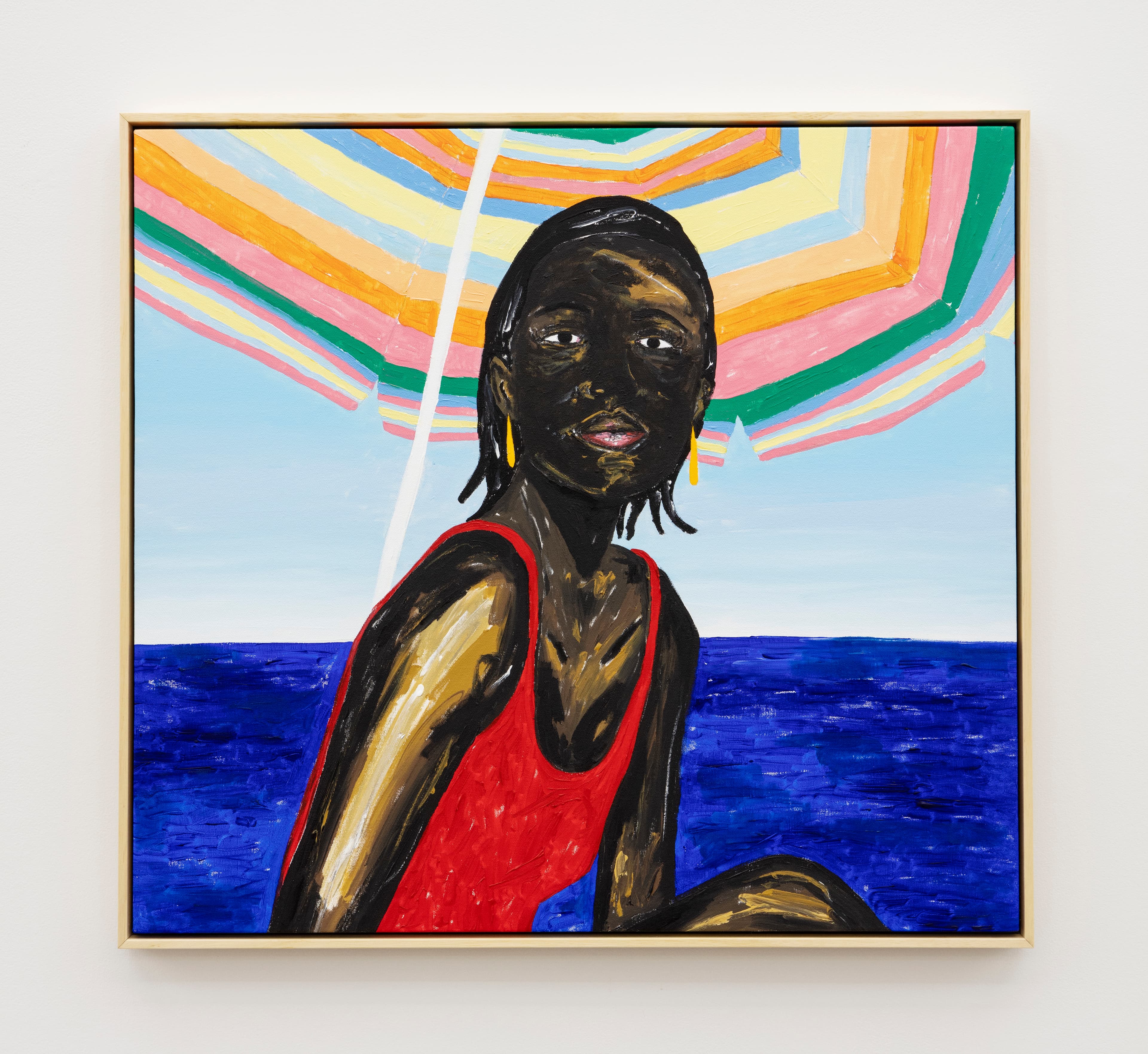
Zéh Palito, Sag Harbor, 1940’s, 2024. Acrylic and oil on canvas, 32 x 30 inches. Courtesy the artist and Perrotin. Photo: Guillaume Ziccarelli.
Perrotin
September 6–October 19, 2024
New York
In Cars, Pools & Melanin at Perrotin, Zéh Palito places Black and brown bodies in pools and cars, both traditional spaces of leisure reminiscent of American consumerism in the 1950s and ’60s. In Sag Harbor, 1940’s (all works 2024), a young Black woman looks serenely, almost blankly, toward the viewer, a bright blue ocean and a vibrant beach umbrella behind her. The title of the work points to the history of Sag Harbor, New York, where the Sag Harbor Hills, Azurest, and Ninevah Beach Subdivisions (“SANS”) served as beachfront refuges for African Americans during the Jim Crow era, during which most of Sag Harbor’s other leisure spaces were “whites-only.” In Sag Harbor, the figure’s gold earrings, red bathing suit, and bright background accentuate her dark skin; centered in the frame, her darkness illuminates her. Palito’s brush strokes are obvious; throughout the painting white shreds of canvas peek through, breaking up the painting’s universe, as is true of all of his paintings in this exhibition. While the main figure dominates the scene, her expressionless face intriguingly opaque, the white of the canvas reminds us that this is a story still being created—more strokes are to come.

Zéh Palito, The Negro Splash, 2024. Acrylic and oil on canvas, 63 x 49 inches. Courtesy the artist and Perrotin. Photo: Guillaume Ziccarelli.
Palito places the canon of Western European art, along with the heavy hitters of Black contemporary art and representation, within his own utopia of unfinished protagonists, often making nods toward famous artists such as Mickalene Thomas, Andy Warhol, Kerry James Marshall, Vincent van Gogh, and David Hockney. While sometimes these homages are smaller scale replicas of works by other artists within his own paintings, others are more obvious depictions, such as Palito’s The Negro Splash, which mimics David Hockney’s iconic Pop art painting A Bigger Splash (1967). While A Bigger Splash depicts a swimming pool interrupted by a splash of water made by an out-of-frame figure, The Negro Splash places a Black woman wearing a papaya-print bathing suit directly in A Bigger Splash’s universe of Californian mid-century Americana. She stares out from the foreground, leaving the wake of the splash behind her, now almost unnoticeable. She demands visual priority, as do all of Palito’s figures, as they stare directly at the viewer. Intriguingly, Palito’s figures have neutral facial expressions. These uniform, unchanging facial expressions across his works lend to the power of each figure’s eyes. Each figure’s penetrating white eyes ground them in their contexts, pronouncing them as more important than their contexts.
In Victor Hugo the Negro Motorist, a Black man wearing a cowboy hat drives a pink Ferrari convertible. The title of the work refers to The Negro Motorist Green Book, a guidebook for African American roadtrippers that denoted safe places to eat or stay, as well as travel routes in Jim Crow America. The figure, again nearly emotionless, has a stone-faced confidence. He does not need to smile, or expand his facial expressions to exist within the context of leisure. He can simply exist, without performing joy. His hand hangs out of the car with ease. His monochromatic outfit adds a sense of whimsy; his all-pink attire further elevates his self-possession.

Zéh Palito, Victor Hugo the Negro Motorist, 2024. Acrylic and oil on canvas, 32 x 30 inches. Courtesy the artist and Perrotin. Photo: Guillaume Ziccarelli.
Palito’s scenes are heavy-handed, but there is value in the obvious. Water is a classic symbol of the Jim Crow era, given laws segregating water fountains, pools, and bathrooms; it also doubles as a space of liberation and humanity. We are born in water (in the womb), and water cleanses us (baptism). Cars are another symbol of the freedom of movement in a country operating under racist systems. Palito’s interest in deeply American contexts of racial segregation, and symbols of liberation, are complicated by his Brazilian origins—Brazil is a country plagued with its own complex systems of race and class. Almost half of the population is mixed-race, and white Brazilians make close to 75 percent more income on average than Black Brazilians. While Palito’s US-based scenes of racial discrimination provide a very different context than those known by his fellow brasileiros, each scene maintains the lushness of Brazilian foliage and tropical iconography, merging ideas of racialized existence between countries and contexts. Black and brown bodies don tropical fruit prints and gold jewelry while they pose in foliage; symbols of Brazilian vibrancy entangled with American references to segregation (and references to Western canon). There is a universality to his figures; they are ideals, utopically placed across time and space in different contexts, but nevertheless deeply present. Regardless of location, in the present or in historic circumstances, Palito’s figures are protagonists.
Palito began his career as a mural painter in São Paulo; the techniques of broader, choppy strokes, bright, blocky colors, and easily-identifiable figures that can be seen from far distances make their way into his smaller-scale paintings, perhaps leaving certain viewers with the feeling that these are empty impersonations, or simply vibrant objects to enjoy. Though the figures are almost always expressionless, this lack of emotion lends an unfinished feeling, just as Palito’s spotty strokes imply. Palito’s figures are not passively seen by the viewer. Instead, they are the viewers. More important than the water or the cars is the right to leisure that they denote, the right for these figures to be opaque, to be self-sustaining, to change a context completely by just existing. These figures don’t require a smile to be leisurely; they just are. They are free to be. They pierce through their contexts, announcing not only their presence, but their leisure. Separate yet tied to their previous worlds, Palito’s figures live in a half-drawn, half-familiar utopia that leaves us wondering: where will they go next?
Priya Gandhi is a writer and comedian based in Brooklyn, New York.