Anne Duk Hee Jordan: Snailing (Slippy slimy slug slut)
Word count: 887
Paragraphs: 10
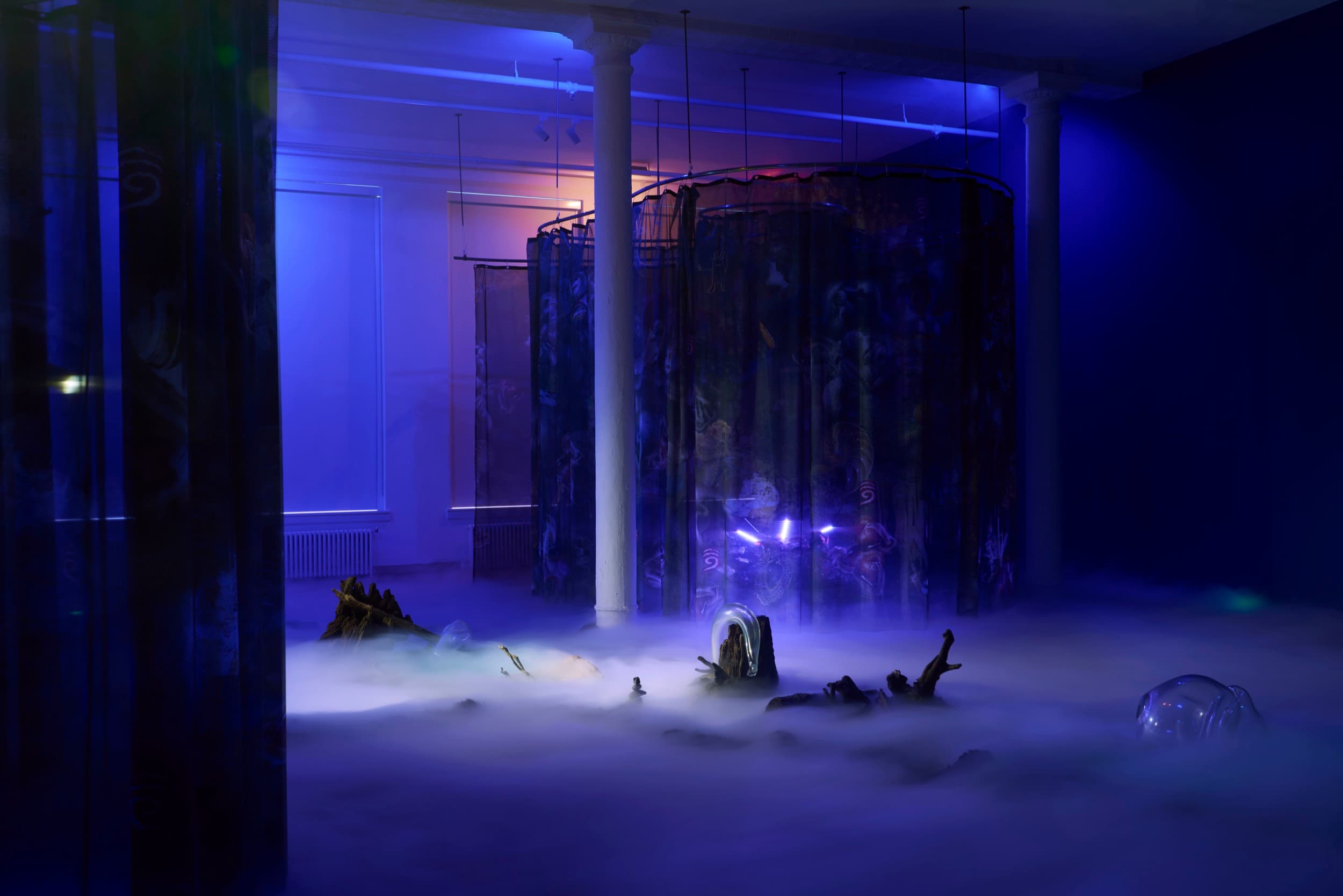
Installation view: Anne Duk Hee Jordan: Snailing (Slippy slimy slug slut), Canal Projects, New York, 2024. Commissioned by Canal Projects. Courtesy Canal Projects. Photo: Izzy Leung.
Canal Projects
September 27–December 7, 2024
New York
In her first solo New York exhibition, Snailing (Slippy slimy slug slut), Korean-born German artist Anne Duk Hee Jordan tells the true story of Jeremy, an extraordinary snail. Jeremy’s shell coiled to the left instead of the right, a rare aberration misaligning his sexual organs. Though snails are hermaphrodites capable of male and female reproductive functions, they prefer to find a mate, which meant Jeremy had to meet another atypical, left-swirling partner in order to reproduce. Fortuitously—or not, we will learn—Jeremy was discovered and delivered for study to evolutionary geneticists in the UK, who named him after Jeremy Corbyn, a left-leaning politician. The geneticists issued a global call to locate a congruent snail mate, wondering if the arranged wedding would produce a new generation of lefties. Seizing the inherent gender and ecological controversies inherent in this event, Jordan’s immersive installation portrays Jeremy’s tale from the snail’s point of view.
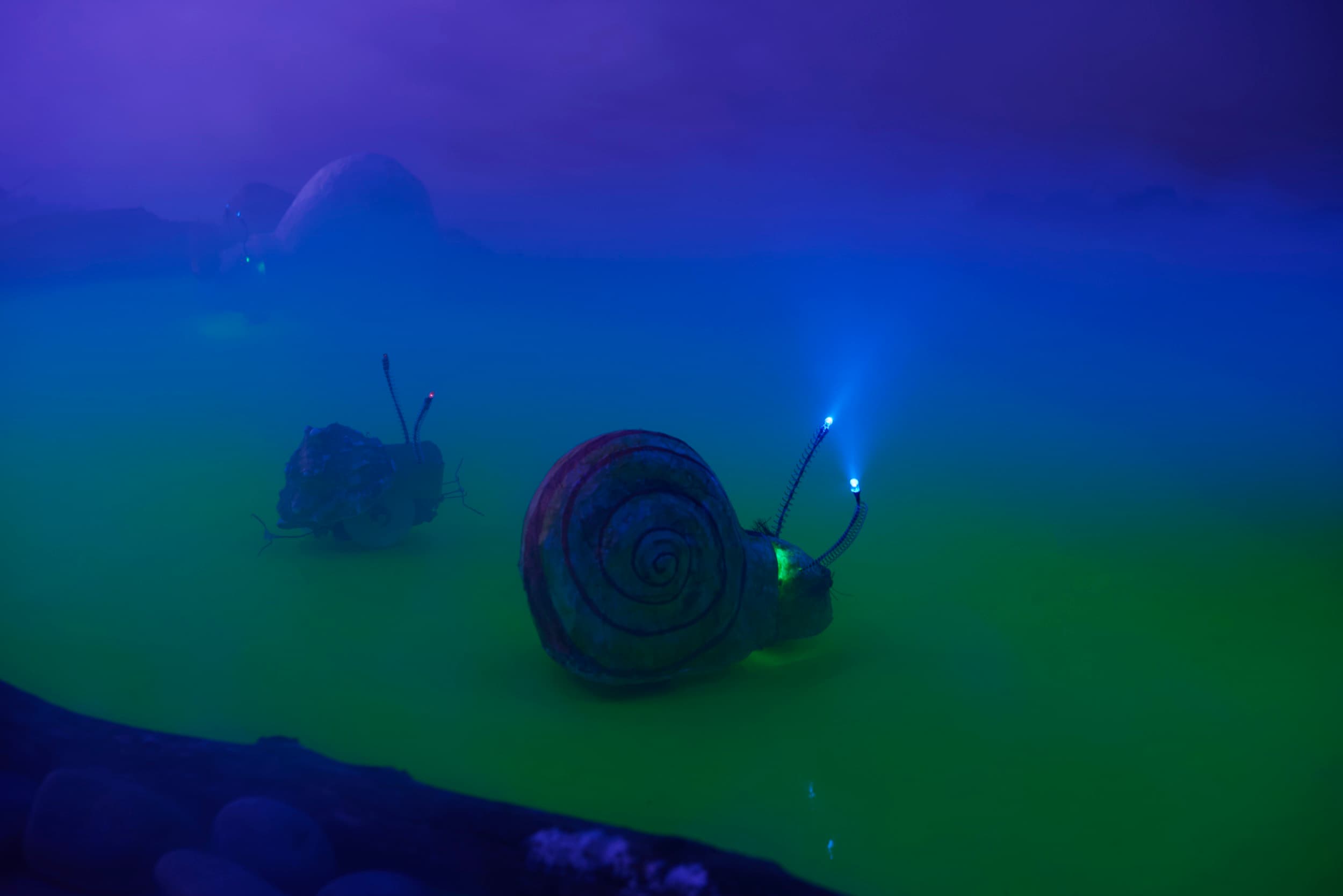
Installation view: Anne Duk Hee Jordan: Snailing (Slippy slimy slug slut), Canal Projects, New York, 2024. Commissioned by Canal Projects. Courtesy Canal Projects. Photo: Izzy Leung.
Well known for setting hot topics in cool spaces, and typical of her practice, Jordan tells Jeremy’s story, bypassing political rhetoric and steeping us within a snail’s world. She has created a sensuous forest habitat veiled in foggy mist, a surround of vibrant blue walls reflecting the light of seemingly infinite space. Spiraling translucent curtains patterned with collaged images of snail life replicate the shape of a snail shell and enclose three circular “Salad Pillow Islands.” The dimly lit interiors of these meditative spaces are filled with live plant sculptures and ambient nature sounds. They draw us in, inviting us to recline and listen to Jordan’s original music softly sung by Sasha Perera. Each island’s sound recording is devoted to one of three narrative verses of a ballad titled Jeremiah. This homage to Jeremy, chronicling his odyssey from celibacy to intimacy, includes the following:
Dr. Angus, with hope and cheer,
Called for mates, far and near,
Two were found, but love’s own thread
Made right-coiled babies instead.
Jordan’s choice to make the snail a hero is consistent with her practice of exploring sexual ecology through the lens of nonhuman life forms, often marine or wormy creatures whose squiggly, slippery textures evoke sexual connections. Though we never see Jeremy crawling about, we do bond with him through Jordan’s intimate “Salad Pillow Islands,” which function like a memorial to a unique creature who produced fifty-six babies before dying in 2017. In her 2024 talk for the Art and Culture Technology Program at Massachusetts Institute of Technology, Jordan discussed Jeremy’s “otherness” and captivity as an opportunity to explore issues of gender fluidity and the fragile balance between natural evolution and human intervention, stressing that “Jeremy’s destiny challenges our binary views of sexuality and existence.”

Installation view: Anne Duk Hee Jordan: Snailing (Slippy slimy slug slut), Canal Projects, New York, 2024. Commissioned by Canal Projects. Courtesy Canal Projects. Photo: Izzy Leung.
Seeing Jeremy as a metaphor for human and ecological vulnerability, Jordan urges us to thoughtfully consider issues of “otherness” and the way we treat those whose gender, ideology, or way of life differs from our culturally imposed norms. Much of her thinking reflects her personal journey. Named Duk Hee (meaning “Goddess of the Sea”) when placed as an infant in a Korean orphanage, she was later adopted by a German couple. “I grew up fighting because kids called me ‘rice eater’ and ‘slits.’ I made gas bombs and threw them into classrooms,” she told me when we met in Berlin at the opening of her 2018 Galerie Wedding exhibition, Ziggy On the Land of Drunken Trees. Before turning to art at age twenty-seven, she trained as a freediver, a rescue diver, and an occupational therapist. Identifying as non-binary and engaging with science and technology, she wants her art to stress the inflection point “where well-intentioned human intervention collides with nature and disrupts natural processes.”
Unlike other recent exhibitions, such as Ziggy and the Starfish (2016–2022), which similarly explored sexual diversity through marine sexuality, Snailing creates a single relationship with a nonhuman, non-binary creature. While snails are treated as pesky disruptors in the garden, eating carefully tended plants, they are humanized through Jordan’s rendition of Jeremy. Jordan reimagines their disruptive behavior by subverting the ways their atypical nature impacts society’s attitudes and behavior toward gender, identity, and diversity. She wonders, for example, if nature’s imperfections, “mistakes,” and unpredictable phenomena—like Jeremy’s left coiling shell—are not part of a larger cosmic plan to foster resilience and adaptation among living things. As atypical life forms interact with the environment, are they not in fact sustaining the precarious balance in the evolution of all living things?
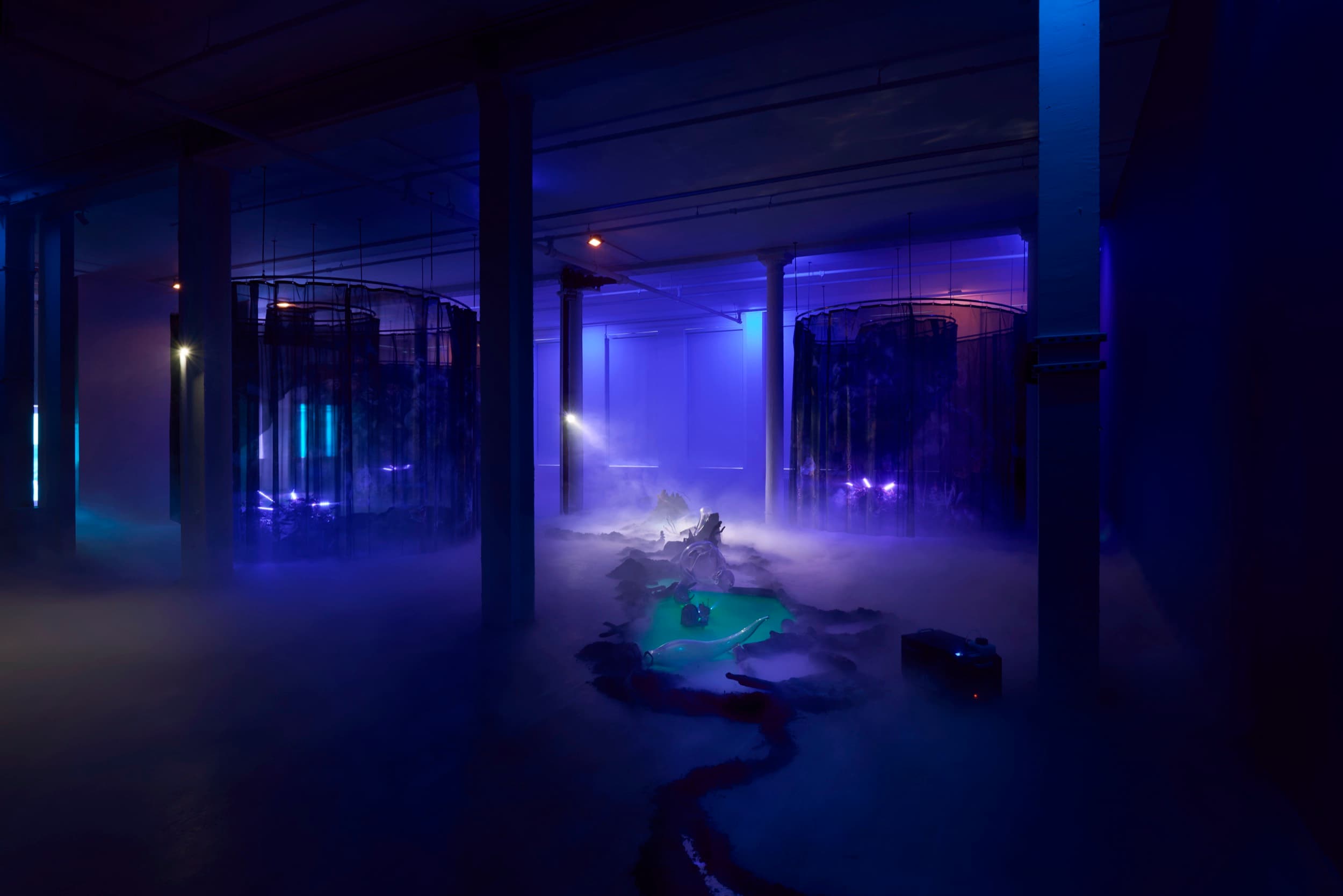
Installation view: Anne Duk Hee Jordan: Snailing (Slippy slimy slug slut), Canal Projects, New York, 2024. Commissioned by Canal Projects. Courtesy Canal Projects. Photo: Izzy Leung.
As we meander through Jordan’s hazy forest, we discover a light-reflecting plastic “stream” simulating neon-colored liquid. This palpably toxic-like construct hosts a strange community of beings, sired by what Jordan calls “artificial stupidity.” They consist of mechanical snail robots cobbled together from manufactured objects, and hand-blown glass slugs draped over desiccated trees, denizens of a post-Anthropocene world resulting from mindless ecological abuse.
With its complex and controversial issues subtly layered within a storybook multi-media installation set to music, Snailing creates a space so enticing, a child gets the story. And then, the adult in the room awakens us. “How will we now handle them?” Jordan, through her work, challenges us. One suggestion: Embrace uncertainty. Look beyond binary solutions as a means of overcoming the human-wrought glitches in an imperfect world.
Joyce Beckenstein is a writer living in New York.