Mike Bartlett and the Brutalist Aesthetic
Word count: 1555
Paragraphs: 18
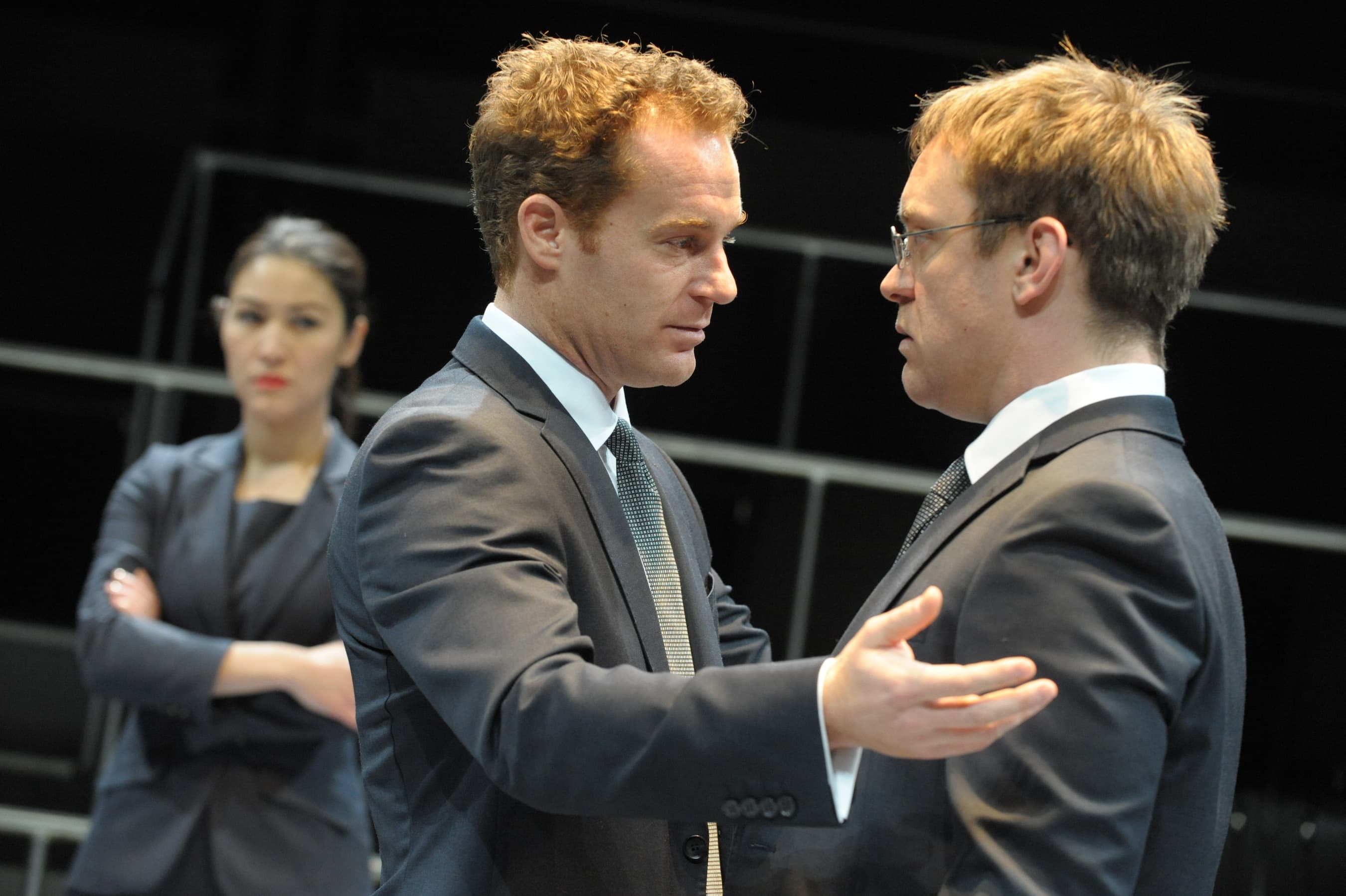
59e59's 2013 production of Bull. Photo: Robert Day.
There was a point, circa 2015, when I was reading a ton of plays, trying to figure out how I wanted to write my own. I was, honestly, annoyed and unimpressed by almost everything—a few stale forms repackaged for contemporary settings—but there were two playwrights, Annie Baker and Mike Bartlett, who seemed to come up with a completely new, completely intact, and thrillingly rich theory of theater.
Interestingly, they were almost perfect opposites. Baker represented a sort of Chekhov revival—getting back to the deep quiet at the heart of naturalism. In an interview, she said, “Silence and stillness are very exciting to me. I feel so over-stimulated and bored by a lot of the theater I see these days because of the breakneck speed at which it’s performed.” The theater that she developed instead was—she said in an interview—based on the surprisingly enchanting conversations that she found herself having with old people, the way the conversations were filled with pauses, were unhurried, and contained almost endless wisdom. Her plays were religious, almost Quakerish, and in the end deeply optimistic about the capacity of human beings to connect to one another.
Meanwhile, Bartlett—no less of a great playwright—advanced a theory of aesthetics that I started to think of as “Brutalism.” The underlying thesis of Brutalism is that there is an intractable conflict between a harsh, vertically-oriented power structure (which is society-at-large) and the soft, decent, human qualities of an individual—and that conflict ends always in the absolute, unconditional defeat of the individual.
I felt that I was coming across that aesthetic in a number of works at the same time—in Lars von Trier’s Dogville, in Quentin Tarantino’s movies, in Michel Houellebecq’s Atomised, and in Game of Thrones—but Bartlett somehow got it into its most distilled form. What made people be awful to other people, his plays were saying, wasn’t capitalism or divisive politics or anything like that. It was something at the very heart of group psychology and social behavior—and that would never, ever change.
Bartlett hit his theme convincingly in his early play My Child—and located that brutality, above all, in romance. A man asks his estranged wife, “Why do you do this to me when you know I’m a good person?” And she replies, with the lack of subtlety that Bartlett turns into high art, “That’s not enough. You lack confidence. You are innocent. Stunted. You refuse to understand money, or responsibility…. You may be good or whatever, but I want someone who … pays the bills for me … and I want someone who has a very clean car.”
In Cock, his breakthrough play from 2009, a man, John, falls in love with two people—a man and a woman—and makes promises to both that he, of course, can’t keep. He spends the rest of the play being reprimanded for it. “What are you?” his boyfriend demands of him. “Most people seem to come together pretty well, their atoms hold, and you can look at them and go oh, that’s my mate Steve, that’s the queen, but you, you don’t seem to have grown coherently. You’re a collection of things that don’t amount. You’re a sprawl. A mob. You don’t add up.”
John seems, constantly, to have some other, better way of being on the tip of his tongue—or just in his reach if only he has the courage to grab it. Unfortunately, that courage is always lacking. His freedom, and individuality, seem precisely to exist through a lack of definition. In order to assert himself, he would have to find some distinct outline to himself—exactly as everybody is telling him to do—and that would break his underlying individual integrity. “Be yourself,” his girlfriend tells him in an effort to buck him up. “But I have absolutely no idea who that is,” John duly replies. In the end, it’s that paradox that reduces John to a state of hapless paralysis—and he simply allows himself to be pushed around by whomever is breathing down his neck the hardest.

59e59's 2013 production of Bull. Photo: Robert Day.
Bull, from 2013, was intended as a companion piece to Cock—the same Brutalist ideas transposed to the workplace. And there, Bartlett’s agonized pessimism reaches something like its clearest form. Three workers, Thomas, Isobel, and Tony are facing a “cull”—mandatory layoffs in which one of them will be fired and the other two retained. Thomas is the most decent of the three, the one who’s been at the company the longest, and the one who needs the job the most. He is also not very attractive—sweaty and dandruffy—and Isobel and Tony team up to, out of pure malevolence, get him fired. Isobel, towards the end of the play, explains herself as follows:
I feel the need to bring you down I think it may be an evolved thing in a society in a culture, that if we see someone who’s going to bring down the whole tribe or whatever … you have the desire deep within you to take them down first to get rid of them and strengthen the tribe … I think it’s instinct, and I think it goes on all the time … I think it’s actually how things are supposed to be.
As in Cock, a sort of deus ex machina appears—in this case, the boss, Carter. Thomas explains the entire situation, throws himself on Carter’s mercy, and Carter reiterates exactly everything that Isobel and Tony have been saying to Thomas—the strong always devour the weak, there’s no room for decency anywhere. As Isobel summarizes it afterwards, “You thought … that fair play and honest, transparent behaviour at work would be rewarded in the end. That bad people like me would fall by the wayside. That’s what you thought, isn’t it? Oops.”
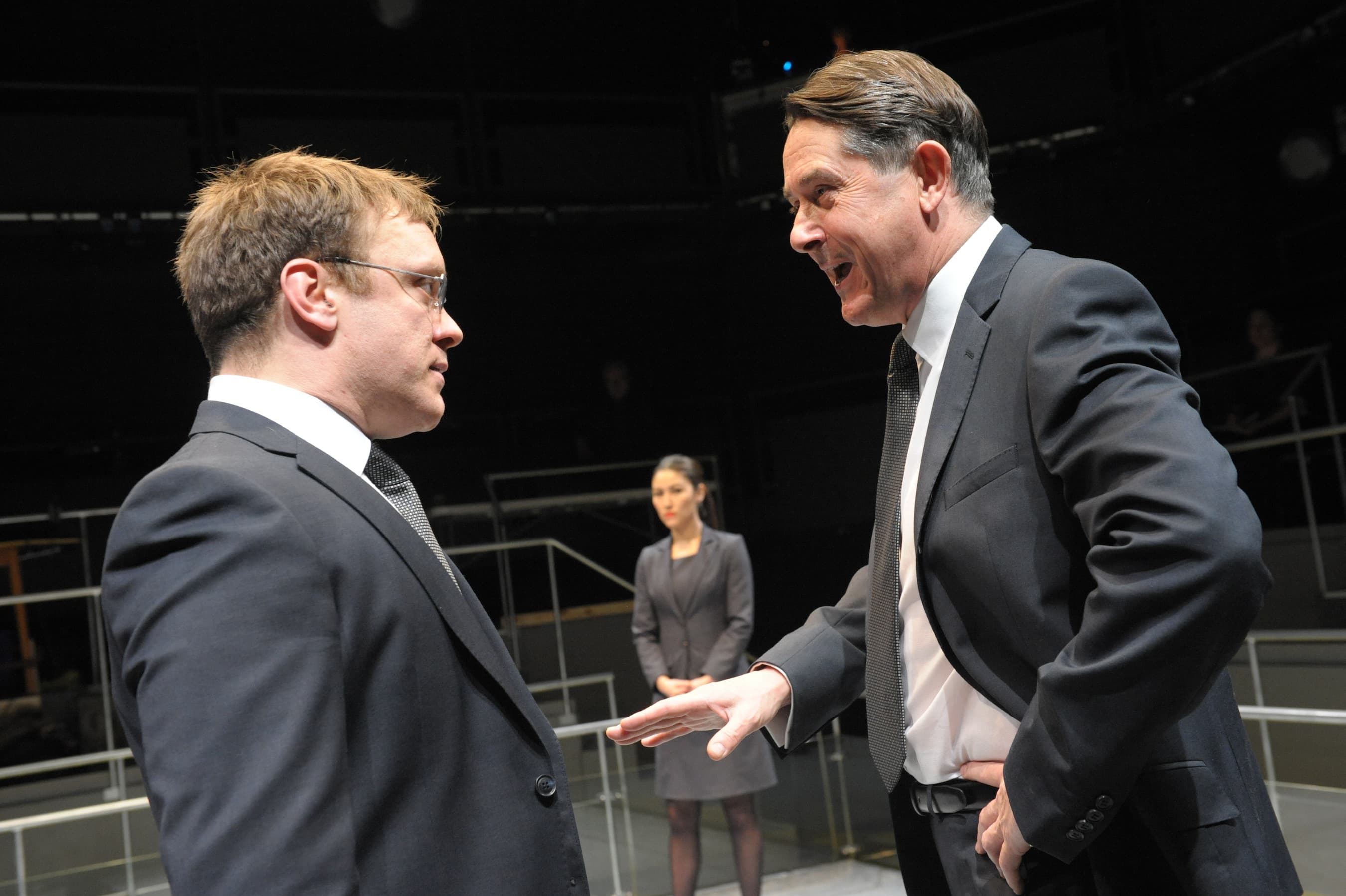
59e59's 2013 production of Bull. Photo: Robert Day.
By the time he’d finished Cock and Bull and the similarly-themed television series Doctor Foster, Bartlett had made his joyless point and was left with the dilemma of what else to do with himself.
In the mid-2010s, Bartlett seemed to come up with a different tack. He would take a tour of all possible political and social issues. Earthquakes in London covered climate change; An Intervention the Syrian war; Wild the Edward Snowden revelations; Albion Brexit; and Game the reality TV-ificiation of contemporary society. As a project, it was definitely a mixed bag. In some plays, Bartlett hit familiar themes—Wild, for instance, eschewed all the usual geopolitical narratives surrounding the Snowden affair to depict Snowden as being just as vertiginously isolated as John is at the end of Cock. Sometimes, though, Bartlett was earnest and issues-based and unrecognizable from his usual acerbic self.
Intertwined with Bartlett’s tour of the issues of the day was another side of Bartlett as a variety show entertainer. This seemed to go back to his playwriting roots when, post-university, he was part of a freewheeling theater company just giving one another permission to “tr[y] different things.”
In 2014, King Charles III premiered, a futuristic history play all in blank verse—an attempt to write as Shakespeare might have done. In 2022, it was The 47th—the same idea but for Trump. And, also, in 2022, Scandaltown premiered—a mashup of Restoration theater language with the contemporary culture wars. The posh Lady Climber having her butler swipe for her on Tinder gives you the general idea.
At some point in here, Bartlett seemed to have overstayed his welcome. Reviews of his work have tended to be surprisingly critical given his out-of-this-world talent, and, in particular with Scandaltown, a number of reviewers turned on him. Scandaltown is “showy but insubstantial,” wrote The Standard, for instance, while Time Out thought it was “good fun but a bit weak as satire.”
I totally disagree with that assessment—Scandaltown is laugh-out-loud funny—but the reviewers seemed also to be missing what Bartlett was up to. Having made his point about the intractable brutality of the world as it is—with that point reiterated across his grim litany of current events—Bartlett worked assiduously to be free of that. Social relations would always have vertical power structures designed at annihilating the individual, but art offered a free space where the individual could be anything they wanted. At one of his hapless moments in Cock, John tries to say something about who he is: “I used to do voices … I’d been doing high voices and northern voices and men’s voices and impressions of the teachers and my dad, and people on the telly and everyone was laughing and I tried to go back to my own voice but I couldn’t remember what it was.”
But, actually, it’s in that loss of the identitarian self that real freedom can be found—and the further development of Bartlett’s career is something like the elaboration of what John was trying to say. Art comes first. It’s possible to get to a liminal zone where anything is possible—where Charles and Diana speak in blank verse and social media consultants in Restoration cadence, where no one is exactly themselves. And, in that fracturing of the individual, as well as of all normal social relations, an almost Buddhistic liberation can be found. Most of his plays feel atheistic, if not nihilistic, but in that creative dissolution of the self Bartlett is, in his own way, just as religious as Baker.
Sam Kahn writes the Substack “Castalia.”