Annie Baker’s Janet Planet
This film is a pensive yet whimsical examination of mother-daughter relationships.
Word count: 1101
Paragraphs: 9

Zoe Ziegler in Janet Planet. Courtesy A24.
Janet Planet
(A24, 2024)
In his 1938 essay Logic: The Theory of Inquiry, philosopher John Dewey argues that a child’s imagination is not usually divorced from real-world logic or experience. Instead, he posits, children draw subjective, often abstract conclusions from their environments, from which they develop their own ideological frameworks. While Dewey was far from the first scholar or artist to identify this concept, Dewey’s cultural matrix theory of inquiry is now a mainstay in educational philosophy and a cornerstone of modern and contemporary artistic ruminations on childhood imagination.
Janet Planet, the directorial debut of playwright Annie Baker, is the latest in a proud lineage of films to which Dewey’s cultural matrix theory is applicable. Unlike Alice in Wonderland (1951), The Wizard of Oz (1939), or Hook (1991), however, Baker’s film is neither upbeat nor sentimental. Janet Planet is a pensive exploration of the dynamic relationship between single mother Janet (Julianne Nicholson) and her introverted eleven-year-old daughter Lacy (Zoe Ziegler). The film examines Lacy’s own cultural matrix of inquiry, informed by the film’s early nineties rural Massachusetts setting and the unsettling strangers Janet invites into their home, including Wayne (Will Patton), Janet’s disturbed boyfriend; Regina (Sophie Okonedo), a displaced cult member; and Avi (Elias Koteas), Regina’s mild-mannered cult leader. Here, Baker encapsulates a summer absent of cell phones, social networks, or anything else that demarcates summertime’s tangible delights from a child’s murky, receding imagination and burgeoning self-actualization—one of the last summers of its kind.
The film’s most powerful moment, conveyed without dialogue, begins with a shot from a car ride that lingers on Janet’s amber oval earring. Baker positions the shot from behind Janet’s ear, indicating that the audience sees Janet’s earring from Lacy’s perspective in the backseat. The camera cuts to Lacy staring at the earring, and her mother, searchingly. Throughout the film, Lacy plays with a makeshift dollhouse populated by Hummel figurines, troll dolls, a wayward Buddha statuette, and clay homemade oddities. Toward the film’s conclusion, Lacy reverently places Janet’s earring on a small dish surrounded by her motley toys and prays before it. This isn’t merely a dollhouse, we realize. It’s an altar.
Unsurprisingly, given Janet Planet’s supporting characters and Janet’s countercultural tendencies (she is an acupuncturist who disapproves of antibiotics), the film has undercurrents of spirituality as both a positive force and an abusive authority. Lacy secretly catches Wayne engaging in a shallow facsimile of tai chi before emotionally manipulating Janet. Regina, having escaped Avi’s cult, is eventually coerced back, away from the safety of Janet and Lacy’s home. Avi encourages Lacy to envision herself as God at the dinner table. Janet repeats mantras of “seeing truth beyond [her] own self-image” to Lacy. Mysticism gradually disrupts Lacy’s conceptualization of her environment and herself throughout the film. For instance, when Lacy encounters costumed performers, she initially interacts with them as if they were really the fantastical animals they were portraying. Later in the film, however, the sight of the performers’ lifeless fursuits and empty masks strung up like carcasses in a butcher shop shatters this illusion.
Through a Deweyan lens, Lacy’s shrine to her living mother signifies the ideologies that permeate Lacy’s pre-adolescence, which merge with a childhood otherwise occupied by T-shirts sticky with melted chocolate ice cream, food courts to be skipped through, and begrudging piano lessons. Lacy’s cultural matrix of inquiry morphs mother and daughter into goddess and disciple (or cult leader and member), while also magnifying the inherent fascination daughters have with their mothers. The shrine also sublimates Lacy’s heightened attachment to Janet as a reserved only child in an isolated community. Above all else, the earring altar’s story arc encompasses a degree of dignity and complexity rarely afforded to films about girlhood, equally reified by Baker’s sensitive writing and Ziegler’s poised performance.
Sobering highlights notwithstanding, Janet Planet is also suffused with austere tenderness, eschewing the low-hanging saccharine fruit of nineties nostalgia for a contemplative approach to its coming-of-age narrative. While the arrival and departure of the film’s supporting characters denote segments, the film is more slice-of-life than plot-driven, bolstered by poetic stretches of silence. For instance, the film features a minute-long unedited shot of Lacy practicing keyboard on the living room couch. Janet walks into frame, standing at the doorway and smiling at her daughter for a couple beats, and then walking out of frame as Lacy continues to pick away at notes, under the impression that she was alone the entire time. This vignette, though mundane and fleeting, is a quietly moving testament to the ways in which mothers selflessly nurture and support their children without recognition.
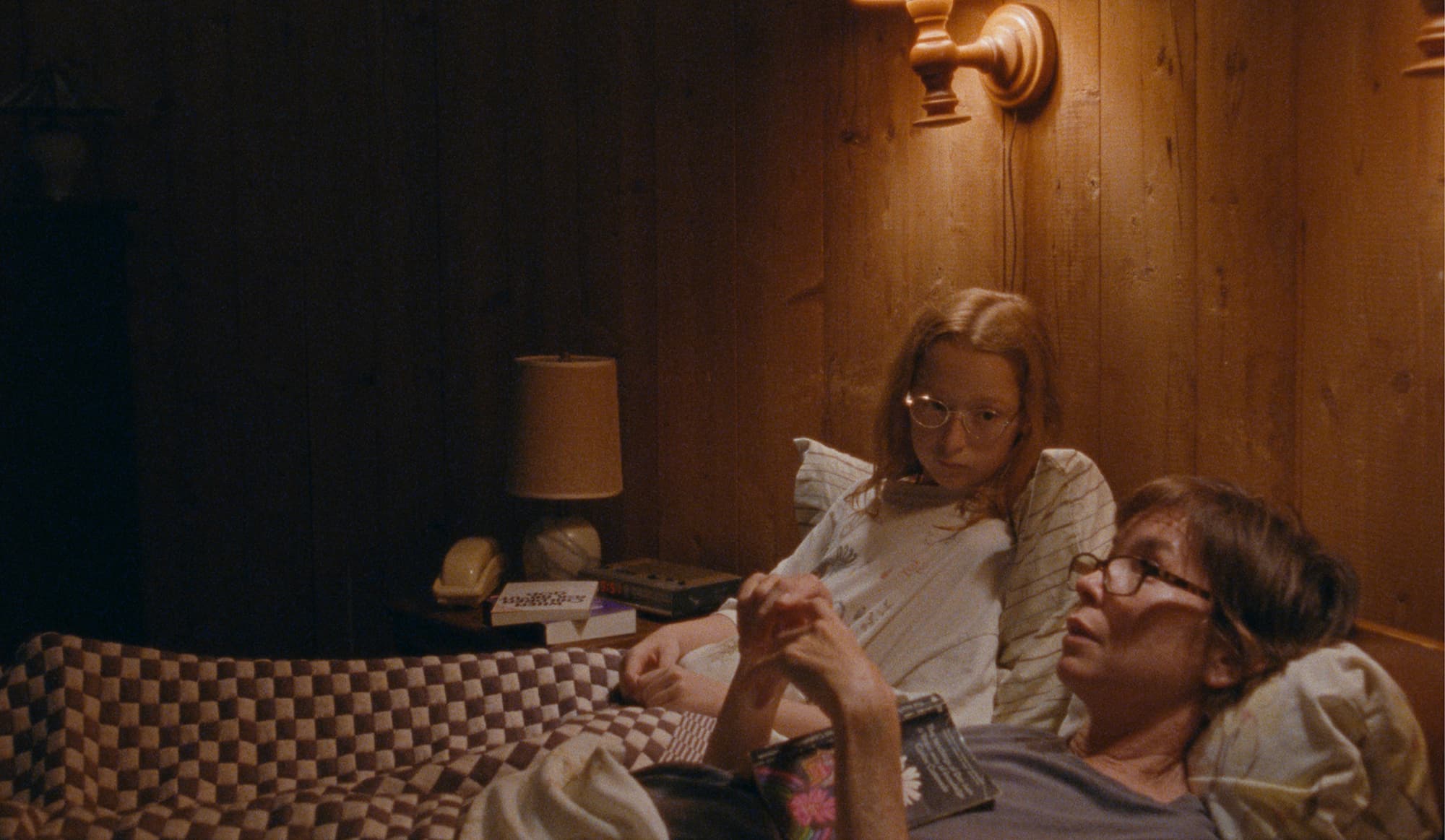
Interludes like these, blanketed in layers of humid August air and ambient choirs of crickets, imbue Janet Planet with the hypnotic, loosely-structured, faintly melancholic qualities of grade-school summers. They also facilitate Janet’s character development. Without diminishing Janet’s flights of irresponsibility, Nicholson’s warm, grounded performance paired with Baker’s nuanced screenplay paint a complex, empathetic portrait of a disillusioned mother (“You develop an identity as an untrustworthy person, untrustworthy to yourself,” Janet remarks in a conversation on motherhood, which Lacy overhears). Baker maintains Janet’s balanced characterization even as cracks begin to form in Lacy’s deified vision of her mother. “I’ve always had this knowledge deep inside me that I can make a man fall in love with me, and I think it’s ruined my life,” Janet confesses to Lacy as they cuddle in bed, one of the film’s most poignant scenes. “I’ve never actually said it out loud before.”
To Lacy, this exchange is an unusual display of vulnerability from her mother and an acknowledgement of the influence men still hold over Janet’s life despite her familial and financial independence. The scene lingers as a portent for the sexist expectations that many women, including Janet, are conditioned and held to. This culminates in the film’s jawdropping conclusion when Lacy learns first-hand that the very same misogynistic and abusive machinations could potentially dominate her own life, even as a child. Perhaps it is Lacy’s perspective that shapes the audience’s interpretation of the film as either an objective portrayal of Janet’s parenting or as Lacy forgiving her mother in retrospect. Regardless, the film manages to depict a relationship between mother and daughter that, in spite of Janet’s apparent yet deeply human flaws, remains loving and unfettered by resentment. For now.
Joanna Seifter is a writer, artist, and museum professional living and working in New York City. She is a recent graduate of NYU’s Museum Studies MA program.