Tulips
Word count: 827
Paragraphs: 5
On View
Kapp KappTulips
June 1–July 26, 2024
New York
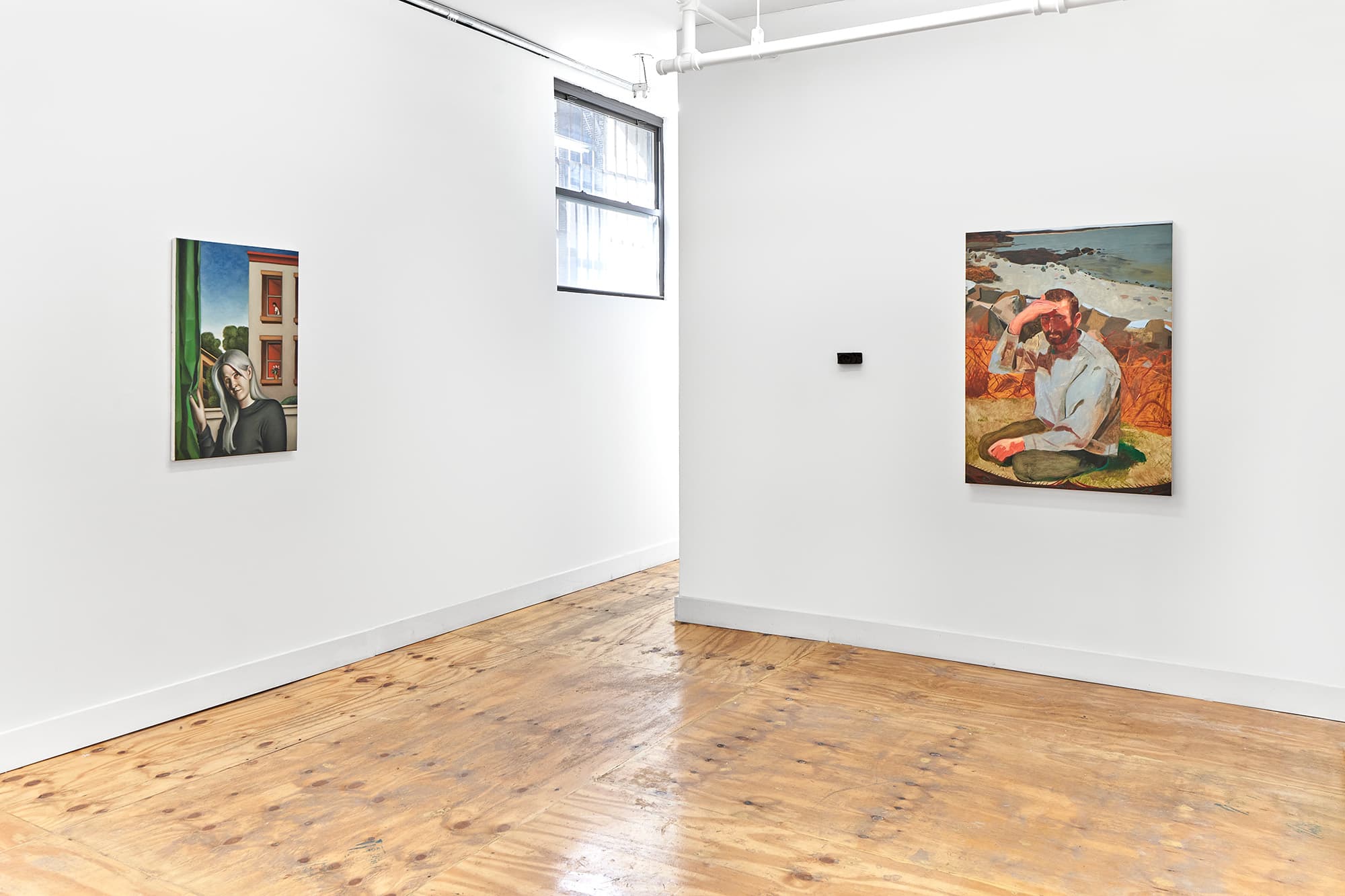
Upon entering Tulips at Kapp Kapp gallery, you will immediately be confronted by a portrait of a lady who stares out of her window at you with forlorn eyes, vaguely smirking because she knows someone is hiding in the Kapp Kapp utility closet. Kapp Kapp does not have a utility closet, so no one has ever hid in it, but this was the beginning of a fever dream. It continued as follows: John Ashbery, back from the dead, jumps out of the closet and screams at me, “You schmuck! You thought the show’s name would make for a light-hearted assortment of summer works! Have you not read Sylvia’s poem?! The one this show is named after?!” I begin to respond that I don’t remember it well, and that summer shows are, well, summer shows, but I am suddenly cut off by the sound of someone running frantically down the stairs. John brings me to the window and yells “Look what you’ve done!” and points to Sylvia Plath, who is now booking it down Walker Street, crying, sobbing at my ignorance, as she makes a left turn on Lafayette, out of sight. John then turns to me, looks around the room, and says, sternly, “And don’t you dare search for a theme.”

This is the second iteration of Tulips and it marks the five-year anniversary of Kapp Kapp and its inaugural show with the same name. The exhibition takes its name from Plath’s poem “Tulips,” and knowing the poem, or at least the fact that it is a poem, may help to clarify the logic of the show itself. In semiotic fashion, Plath uses the tulip—a sign which implies rebirth and hope—to subvert its associative meaning. In the case of her narrator the tulips are a source of pain and violence within her sterile hospital room. It is here that we see how recontextualization—placing the tulips in a particular setting, for a specific person—changes the inflection of a given sign. This is true of Kapp Kapp’s Tulips as well, wherein Sam Kapp, the show’s curator, works on the basis of relativity and recontextualization; there is no obvious conceptual through line or declarative higher meaning to this exhibition, but the show’s success lies precisely within the welcome absence of such. Welcome because this absence makes room for each work to mobilize and alter the inflection of one another—no longer tethered to the wall by a spoon-fed point, no longer in the shadow of a dogmatic exhibition statement. Thus, we feel the works, we author our own patterns and disjuncts between pieces, we revel in the show’s heteroglossia.

One example of this authoring may proceed as follows: To the right of the impressive (and knowing) portrait—Justin Liam O’Brien’s Green Serenade (2024)—is Anthony Cudahy’s pebble eroded above and below (2024), whose subject shields his eyes from the sun as he looks to the middle of the gallery where Louis Osmosis’s Centrifugal Pickle #1 (Fly Trap) (2024) hangs from the ceiling. A synthetic rose crowns this sculpture, catching the eye of Martha Stewart in Sam McKinniss’s Martha Stewart Arranging Tulips at Home (2024), who considers adding it to her arrangement, smiling at you because you thought the piece to her left, Thomas Blair’s A luxurious still life in the style of late Irving Penn (2024), was painted and not printed with inkjet. Across the way is the divine explosion of impasto in Alicia Adamerovich’s Waiting in line to shine (2024), the aftermath of which has gathered onto the canvas of Cynthia Hawkins’s Investigation into Green (1986). Now that color has been investigated in full, we welcome the black-and-white photograph Mr. NY Leather Kiss I (1987) by Stanley Stellar, in which a cosplaying cop and a man in a flannel shirt kiss, their pose mimicked by the manga-inspired painting Blossoming Friendship (2024) by Julien Ceccaldi five paces away. Each work represents a different world, a different point of view—anomalous yet intimate—but under the same roof, they grant us that thrilling access to focus particularly on the motion between them, constituting a field of action.
It took me some time to realize why John Ashbery emerged from the utility closet during my episode, and I think now that this is precisely it. Ashbery often began with a title as a way to locate an abstract idea, and from this the poem would follow, effectively subverting the explication of capital M-Meaning, or at the very least, not aiming to declare such—I have a feeling that Sam Kapp did much of the same. So go to the show, but in Ashbery’s artificial words, “Don’t you dare search for a theme.” Instead, open yourself to the field of action on Walker Street and let the rest follow.