Rita Ackermann: Manna Rain
Word count: 1029
Paragraphs: 11

On View
Fondazione IrisOrganized by Amanita Gallery
Manna Rain
June 10–July 30, 2024
Bassano in Teverina, Italy
Passing through a stone doorway, my eyes meet the unblinking stare of a large Afghan hound. It is one of many Roman and Etruscan sculptures collected by Cy Twombly that sparsely populate the bright, spacious rooms of a seventeenth-century palazzo in Bassano in Teverina, an hour’s drive north of Rome. The palazzo, which served as one of Twombly’s studios from 1975 until his death in 2011, now houses the Fondazione Iris, started by his family, and will eventually become a study center devoted to Twombly’s legacy. Until the end of July, it also hosts Rita Ackermann’s exhibition, Manna Rain, organized by Amanita Gallery, presenting framed works on paper, canvases, a film, and a site-specific mural produced during a residency there. Hungarian-born, New York-based Ackermann is the second artist invited to work and exhibit in this charged atmosphere.
Beyond the marble hound, a tall window offers an imposing view: verdant green hills, a line of cypresses ascending a slope, a patchwork of bright yellow ochre and green rectangles, and deep blue mountains tracing a distant high horizon. Closer by, the hot sun reflects on the rooftops of this tiny town with its Renaissance clock tower that holds a secret: a Medieval tower concealed within.
While all painting is essentially a transhistorical dialogue, in the sense that every painting is informed by the memory of other paintings, this exhibition constitutes a dialogue in absentia between two artists. None of Twombly’s works are on view, but his presence looms large. Ackermann expands the conversation, responding to Twombly while engaging with her own work. Her mark-making at times conjures Twombly’s gestures. Both artists eschew the distinction between drawing and painting, avoid volumetric presence, and favor automatism. However, while Ackermann’s images share some of Twombly’s sensibility, they are also self-referential.
Ackermann’s early 1990s works featured almond-eyed prepubescent girls engaged in idleness or self-destructive behavior, waif-nymphs rendered in an informal graphic style with strong black outlines. In a subsequent period, she moved away from legibility, but her seminal figures reappear here, abbreviated and transformed into fragmentary presences with vulnerable expressions.
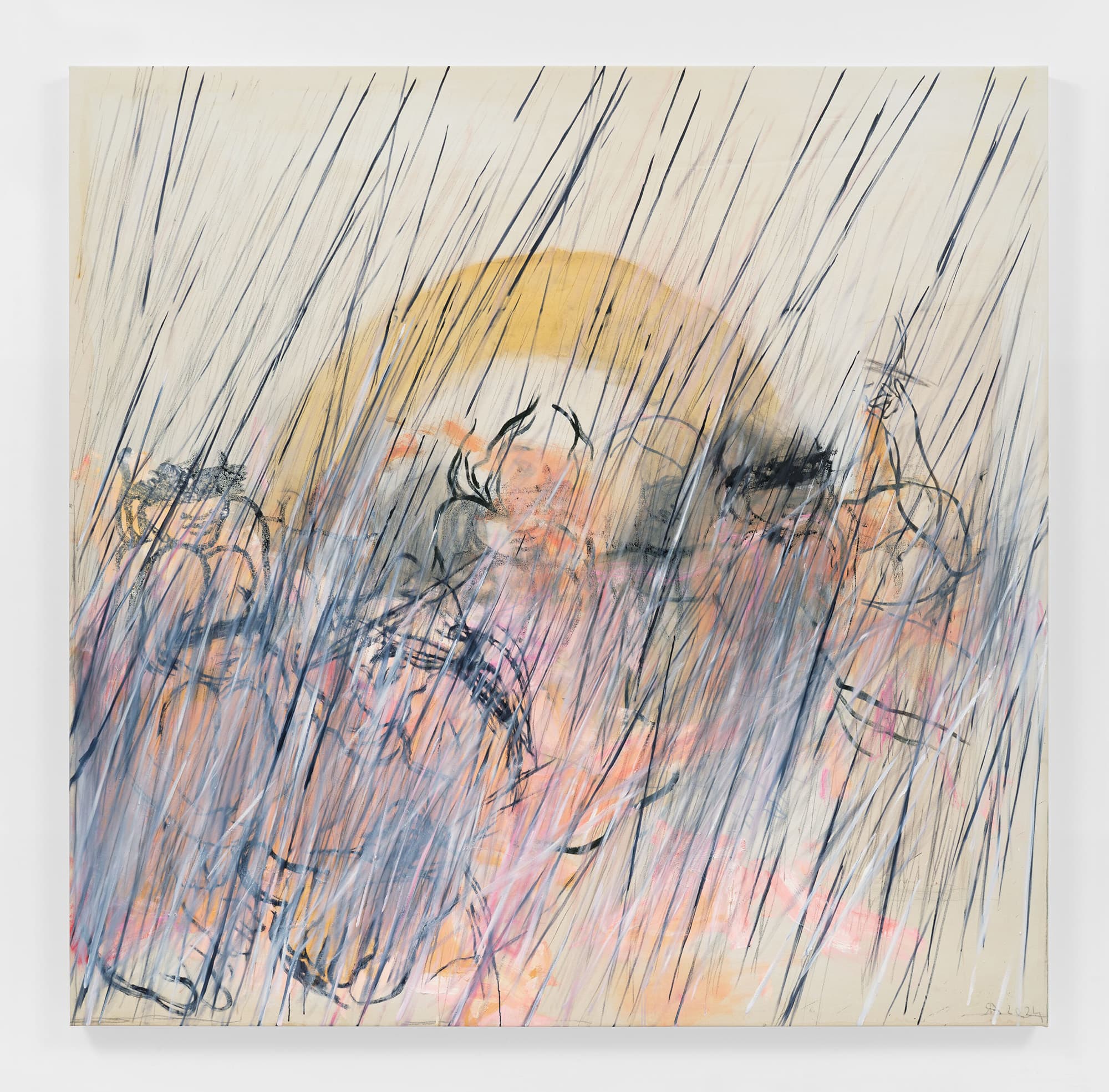
One such figure appears in Loss of Innocence. On the left-hand side, a tangle of broad black vertical lines reads as pairs of slender legs. On the right, a crouching girl’s eyes are obscured by a diagonal black band, suggesting a blindfold or censor’s mark. The work is graphic and fragmentary, full of vaguely violent and uneasy implications. In Sound of the Wind, the same figure is depicted multiple times, inverted or mirrored, and the composition’s horizontal bands call to mind disjointed analogue film strips. Cinematic references are also found in works like Mouchette in Hollywood and Black and White Film. In the titular Manna Rain, a girl covering her eyes with her hands appears above a cloud formed by smudges of white and gray pigment and forceful diagonal strokes, recalling a violent rainstorm (a direct quote of an untitled work by Twombly from 1970.) Below, a series of simplified hands, overlapping legs, and a single exquisite horse’s hoof emerge from a palimpsest of turquoise lines.
These repeated motifs create continuities and perpetuate a trope of concealment. Ambiguity, vulnerability, and indeterminacy are ever-present, with broken contour lines, acts of cancellation, superimposition, and redaction throughout. Ackermann has noted her interest in French media theorist Paul Virilio, particularly his writings on perception and disappearance. These ideas harken back to her earlier engagement with Twombly in her chalkboard works from a decade ago, revisited in her large site-specific mural, Ubiquitous (Outside of Time and Space), which occupies two planes of intersecting walls on an upper floor. Composed of white pastel line work against a green void and a large central flow of diaphanous white and magenta erasure, the mural's energy is less calligraphy than choreography. Random pictorial events with simplified iconography populate the periphery: inverted ankles and feet, a tiny flag, or a bloated elliptical shape resembling a child’s drawing of a submarine or UFO.

Ackermann admirably responds to Twombly’s love of classical and antiquarian subjects and his capacity to create psychological tension via embedded cryptic scrawl. In one room, the mask of a tragic actor in Parian marble is positioned next to Ackermann’s Bronze Tears, whose mineral dry facture, dominant red, off-white edges, and oily-stained central yellow rectangle recall the severe beauty of a decaying Pompeian wall painting. She has summarily painted one of her signature girls' faces over an old print of an antique bust, and a column of wobbly letters descending into a well of graphic marks references both her own work (a series entitled “Mama”) and Twombly’s conflation of writing and drawing.
The materiality of Ackermann’s work here is also striking. The textured masses of paint of her “Mama” works are absent; her surfaces are built up with crayon, pastel, monoprinting, pasted-on paper, and lines scratched into thin wet oil paint. In some paintings, the bare canvas support is visible at the edges, its flaxen hue framing the arena of concentrated gestures. Her lines are initiated, abandoned, and veiled. They contour a receding form or limb, are interrupted and begun again, contrasting with Twombly’s line, which circled back on itself.
Interestingly, while Twombly’s gestures embody the childlike, Ackermann depicts the child, hidden and obfuscated within her compositions. His graffiti and scrawl-like marks channel early psychological states, while her works integrate young figures whose body language expresses them. This need to articulate primal mental states was a modernist ambition: to access unmediated thought and think directly in pictures.
Manna Rain develops Ackermann’s pictorial tensions and troubling psychological imagery, operating between the visible and the masked. Her mural will eventually be painted over, fittingly aligning with ideas of erasure and concealment. I left contemplating the struggle between mind and hand and what the mind will allow the hand to create.
François Xavier Saint Pierre is a Canadian painter based in Venice. He has been an artist in residence in the UK, in Sweden, and at the French Academy in Rome. A mid-career survey of his work was presented in Toronto (2021-22), in Venice (2022), and in Rome (2023) at Palazzo Borghese.