Tree As Architectural Metaphor
Word count: 955
Paragraphs: 9
The tree is the perfect architectural metaphor, stripped to its parts; it resembles the fundamental analogy of a building’s elements: roof, structure, footings: canopy, trunk, roots. The tree feels the same pressures as a building. To create shade, to create enclosure, to find the sun, to stand in the wind and stay dry in a flood. The lessons from trees are as present today as ever, they are living fossils of the past and insights into our future.
Imagine a world devoid of trees—our planet, stripped of its verdant sentinels, illustrates a barren horizontal landscape, vast expanses of open ground lay exposed and scorched by the unyielding sun. The air stagnates as a dark veil, casting a suffocating pall over the land. The soil erodes and dampens as torrential rains crash into the unprotecting earth, funneling mud into the rivers as their banks crumble into murky, dense waters.
This treeless Earth stands as a stark testament to the role of forests in constructing the ecological scaffolding of our existence. 485 million years ago, our modern moss's ancestors, primitive Bryophytes, transitioned from aquatic to terrestrial environments, initiating the formation of the first soil and atmosphere. Subsequent evolution, like the development of vascular tissues in plants like Cooksonia, facilitated taller growth. The emergence of the first true trees, such as Archaeopteris, introduced woody trunks, extensive roots, and leaves, significantly impacting the environment. Their roots aerated soil through the erosion of rocks, their organic matter decayed and formed humus fertilizing the soil, their leaves increased oxygen levels, absorbed carbon dioxide, and cooled global temperatures.
Our civilization, and the evolution of our species, would have charted an entirely different course without the primary habitat of our arboreal ancestors. We have indeed co-evolved alongside trees and they have profoundly shaped our existence. Yet, despite this ancient interconnection, human civilization and the built environment have largely relegated trees to the social periphery. Urbanization, deforestation, and industrially-driven climate change have profoundly impacted forests, resulting in significant biodiversity loss and ecosystem degradation. Forests, once central to our survival and development, have been sidelined by the relentless expansion of human infrastructure. The ongoing encroachment into forested areas disrupts these vital ecosystems and undermines the very foundations of our world's stability.
In her foreword to The Architecture of Trees (2019), Laura Conti speaks of the increasing need for green spaces in the modern world. Historically, in many cities farmland could be found just outside their borders, especially before the widespread industrialization and urban expansion of the nineteenth and twentieth centuries. As cities grew, they expanded into surrounding rural areas, subsuming farmland with urban development. As the gap between the city and the countryside shrinks, the integration of green spaces in the urban fabric becomes a much more urgent need. Green spaces today “are places for becoming aware of and perceiving the things that make up (or at one time made up) our land (soil, grass, trees, wind) and they are spaces where we can perceive and possess undivided land.”
The results of millions of years of evolution is richly illustrated in The Architecture of Trees. In the introduction Cesare Leonardi and Franca Stagi reveal trees as complex architectural entities of constant flux. The botanical illustrations in the book read as architectural elevations, rendered at 1:100 with a meter and feet scale ruler as its guide. It is a compendium of over 550 analytical drawings, a comprehensive visual documentation of each species' structure. The size of the book is directly in tandem with the scale of the largest tree illustrated, the Sequoiadendron giganteum. All the species drawn were studied through direct experience and meticulous observation, inviting the reader to share this attunement: “by observing trees we can perceive the passage of time and the changing seasons.”
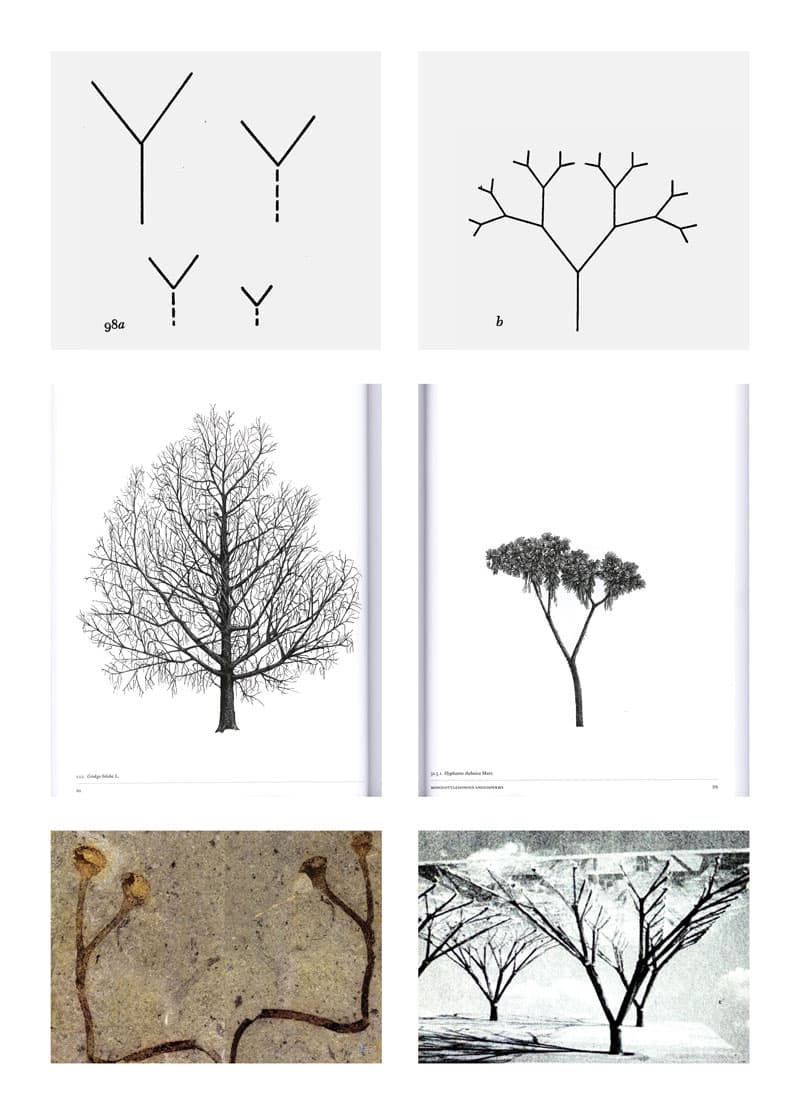
Observing nature reveals that all forms and patterns, whether influenced by gravitational, mechanical, or biological forces, are ultimately subject to the tyranny of space. A tree’s shape is dictated by the contours of its branching pattern just as a leaf’s shape is dictated by its vein pattern. The arrangement of leaves on a stem that influences the arrangement of twigs on a branch and thus, the arrangement of branches on a limb. Everything about a tree's growth follows a fractal pattern of modular and repetitive growth that repeats at various scales within the organism. The most primitive growth pattern in plants is dichotomous branching, where the growing tips of each branch produce two equal branches, each of which subsequently splits into two more branches and so on. The fossil of the 432 million year old Cooksonia (tree’s vascular predecessor) exhibits a clear dichotomous branching pattern. Other modern species such as Hyphaene thebaica (the Doum palm) and Ginkgo biloba also share this arrangement. This is further represented in the innovative architect Frei Otto’s structural studies from the early 1960s, where columns support branches to connect roof points to a single point on the floor using minimal material in a direct route.
Trees act as dynamic architects of our environments and their intricate patterns illuminate fundamental principles of growth and adaptation which respond to stimuli much like our own buildings address functional and programmatic needs to contextual and cultural forces. Trees’ impressive array of adaptations to change can suggest new insights into our own design practices. By studying trees, we can create more sensitive and adaptive architecture, moving beyond mere hermetic structures towards an architecture that responds to, enhances, and participates with the natural world. In so doing, we can embrace concepts that merge ecological sensitivity with technological prowess, fostering an adaptive and responsive built environment.
Jessica Martin is a contributor to the Brooklyn Rail.