Jiajun "Oscar" Zhang’s All, or Nothing at All
Making one debut feature is hard enough, and Zhang has crafted a two-part film with a playing order determined by the flip of a coin.
Word count: 1335
Paragraphs: 9
All, or Nothing at All
(Factory Gate Films, La Fonte, 2024)
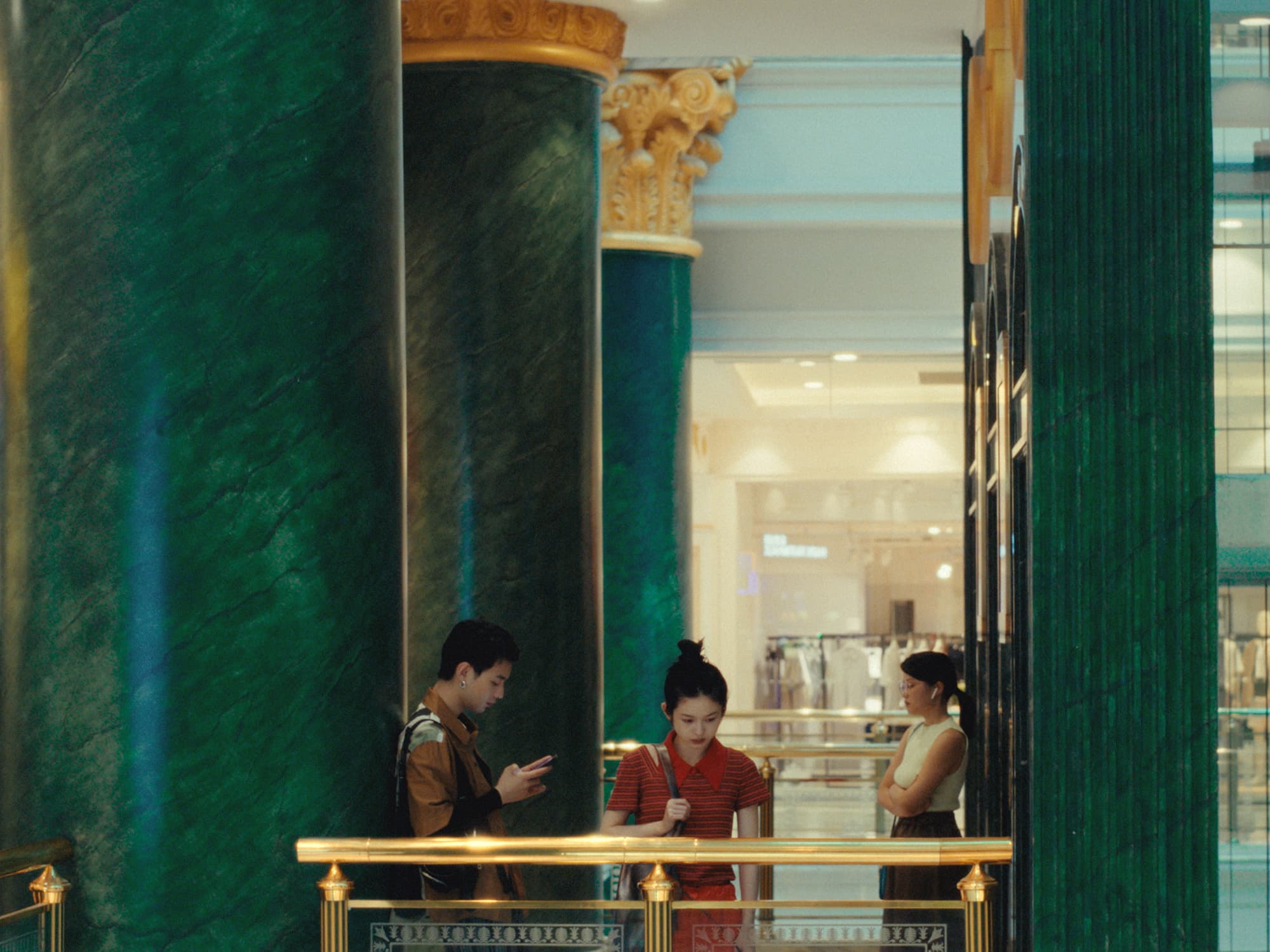
Jiajun “Oscar” Zhang’s remarkably ambitious first feature is actually two movies in one. Each segment, titled “Nothing At All” and “All,” are about an hour long, and the director insists they can be played in any order. I saw the film’s A-side, which follows title order, at Lincoln Center in April, when it made its North American premiere as part of New Directors/New Films; the B-side played at MoMA the following night. Both parts star the same cast of over thirty performers in altered but analogous roles, and both films take place entirely within the premises of Shanghai’s Global Harbor shopping mall, a six-story monstrosity with seemingly endless corridors and annexes. Making one debut feature is hard enough, but Zhang has successfully enriched and deepened his themes—of performance, surveillance, sincerity, and exchange—by presenting these two parts in ambiguous relation to one another, with a playing order determined by the flip of a coin.
The Global Harbor shopping center is mostly subterranean, with two square towers of residences that loom above the faux-classical dome of the shopping center’s roof. Zhang, who grew up not far from where the neon-colored complex was built, spent several years in the United States before moving back to Shanghai to wait out the pandemic in 2020. He remembers going over to friends’ houses as a child in the working class neighborhood that was razed to make way for the mall. “The district was full of factories and collective-style workers’ housing and was proud of its workers’ culture,” Zhang informed me via email. “I witnessed the decline of state-owned factories and the arrival of mass redevelopment and consumerism when I grew up.” By the time he entered high school, in 2004, almost all the collective housing had been pushed aside to make way for high-rises. Global Harbor, which was constructed between 2008 and 2013, now serves as an informal monument to this era of class restructuring in China.
As Zhang and his partner, co-writer and production designer Hee Young Pyun, endured the pandemic, they began spending nearly every day at Global Harbor, filming the quotidian interactions between patrons and service workers from the odd angles afforded by the mall’s many floors. Hee was shocked to discover that many other people visited the complex at least as often as they did; instead of searching for things they wanted or needed, they seemed to “wander around aimlessly, like ghosts,” as Hee recalled in a post-premiere talkback. Meanwhile, store representatives waited interminably for someone to show interest in their wares. The resulting dance couldn’t really be called shopping or entrepreneurship. It was more like a sterile, commercialized version of everyday life.
Some of the footage Hee and Zhang shot makes it into “Nothing at All,” where a young man named Lan Tian (Yu An) has a similar pastime. A shy film geek, his desire to make a movie inside the mall leads him into an obsession with Yoyo (Chen Xiaoyi). She works at a makeup counter where most passersby won’t even take a free sample. Lan Tian finds constant opportunities to film her with his phone, and, while it seems as though she might like him back, Yoyo is conscientious of another presence watching her: the mall’s security system, which occasionally posts online pictures of workers behaving unprofessionally toward customers.
An and Chen likewise star across from one another in the “All” segment, playing characters with the same names who are nevertheless so different that it's difficult to imagine what kind of temporal leap has been made. In this version, Lan Tian now works the front desk of a hip-hop dance studio nestled somewhere within the mall’s many floors. He’s in love with Perry (Liang Cuishan, who previously played the manager of Yoyo’s makeup counter and here plays a rich woman who lives in one of the towers above), and scarcely seems to notice a girl named Yoyo, who takes every chance she can to bump into him. Across both segments, an imbalanced relationship persists between service employees who are required to spend time at the mall, and their prospective customers, who seem to have nothing better to do than obsess over them. Other than cups of coffee, no one buys anything.
The American mall movie is more or less obsolete now thanks to Amazon, with 2009’s Paul Blart: Mall Cop presaging the endangerment of physical retail. From Woody Allen and Bette Midler’s insipid squabbles in 1991’s Scenes From a Mall to Kevin Smith’s proudly mind-numbing Mallrats (1995), the subgenre largely existed as a staging ground for shallow satires of Western consumer culture and one’s spiritual emptiness in the face of its decadence. This sense of agency as anesthetized by abundance becomes more complicated when set in Shanghai, a city where behemoth malls abound. Zhang describes his experience growing up in a city where shopping centers represented the most accessible form of what sociologists refer to as third places, neither work nor home, “where the kids play hide and seek and old people rest.” Perhaps the sense of hide and seek (or cat and mouse) that persists throughout All, or Nothing At All was born from such childhood games. But by keeping the role of the seeker consistent between two versions of a film where nearly all else changes, Zhang has created a complex and unresolved metaphor for the act of shopping itself.
Depending on which order you watch, the gap between the two narratives suggests either a few years’ leap in time or an extended flashback, and the intertwined climaxes of both support this assumption. But while a theory of continuity between the narratives is rich and exciting when it comes to drawing meaning from the film, it also leaves several questions unanswered. Yoyo and Lan Tian don’t seem to remember much of each other’s past lives. If the story is contiguous, Lan Tian has somehow transitioned from a scrawny film geek to an aloof hip-hop dancer, with seemingly no affinity between the two men. Yoyo is even more enamored by this coolly evasive dance instructor than his nerdy, boyish alter ego ever was by her, and there’s no sense of irony about such a reversal. The overall effect disrupts continuity, especially in the realm of what might be called character growth. Instead, we are left with a sense of rupture and dispersal. With the knowledge that the two events could just as easily be reordered, and the fact that neither narrative “side” is privileged over the other, the film implies that its cycle could go on into infinity. And because this same night-and-day switch is made by even the most minor characters (other than the barista, who pours latte-art hearts into each lovestruck shopper’s coffee) the message it suggests is almost anti-humanist—a society of people entirely reduced to their roles.
But perhaps that’s the point—the mall is not exactly a humanist space. Its sheer size (plus the fact that the ones in Shanghai look not unlike the ones in White Plains or Denver) remind us that these spaces are less shrines to the individual’s freedom of choice than to the impersonal transactions that keep global systems of capital churning. There’s a sense of dissociation that comes from spending time in a space dedicated to the consumption of goods and realizing that the people who buy and sell these products are merely manifestations of the transaction itself, that others would replace them if they didn’t show up. By grafting this sense of anhedonia onto two directionless stories of unrequited love, Zhang’s movie makes Lan Tian and Yoyo’s deepest feelings seem impersonal from the serene perspective of supply and demand. It’s thrilling to watch, if only because it catalyzes us to reject its perspective.
Nolan Kelly is a writer and filmmaker based in Brooklyn, NY.