Word count: 1154
Paragraphs: 15
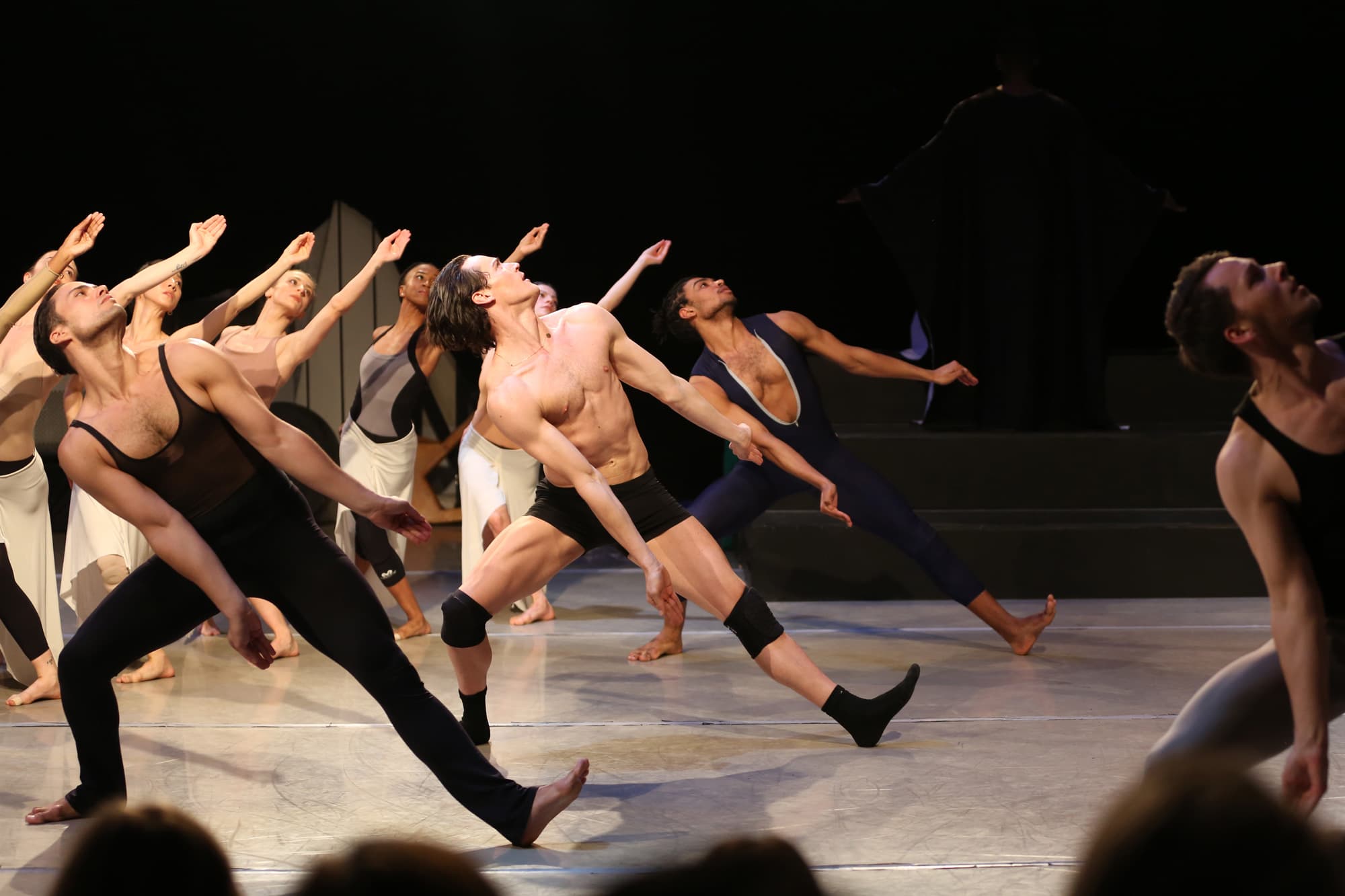
Martha Graham began with the men. Watching them today, forty years after she set their steps, they enter one by one with long, halting strides and straight arms ending in Graham’s signature cupped hand. Their chins are raised to the studio’s stage-like lighting and sweat already beads on most of their foreheads. At lower Manhattan’s Westbeth Studios on Wednesday, March 13, in an open rehearsal of The Rite of Spring, the air is hot. Some of the men wear shirts, others only tight shorts mimicking the costumes they will wear onstage in Martha Graham Dance Company’s City Center program, April 17–20. In this pre-performance presentation, many of the dancers also wear kneepads—a harbinger for the type of choreography the audience is in for, as if we don’t already know from Rite’s legacy, Graham’s oeuvre, and Stravinsky’s pounding, haunting score.
The audience sits on chairs and floor mats in long horizontal rows at the front of the studio. From my dancing days, I know the particular challenges of a studio presentation: dancing full-out without the distance a proscenium provides. Here, the audience occupies space that would normally be a buffer zone, an orchestra pit or a stage ledge before the first row of seats, over which the dancers can project their movements and emotions. This close, we can see the tiny muscles and tendons of each ankle working to balance a still pose. In a mid-air leap, I catch a dancer’s eyes darting sideways to check that he is in line. Though it’s challenging for the dancers, this might be my favorite way to view dance: intimately near, their training and agility on view mere feet away, appearing not effortful, but powerful.

Unlike the men, the women enter all at once in a line, bare feet propelling them across the studio in front of the Shaman character, danced by Alessio Crognale-Roberts, who is a statuesque force overseeing the community that gathers before him.
In a brief talk to kick off the rehearsal, artistic director Janet Eilber and Graham Company alumna Jacqulyn Buglisi, a member of the piece’s original cast, told stories from the piece’s creation. According to them, although famous fashion designer Halston holds the costume credit, Graham took his fabric bolts in her own hands and draped the final design herself. Graham’s first encounter with Rite was in 1930, when she starred in the American premiere choreographed by Léonide Massine. She would take on the piece herself over a half-century later; Graham’s Rite debuted in 1984 when she was ninety years old.
Four decades after that, I am trying to recall what the world was like when Graham chose to stage Rite. Reaganomics, I guess, as I watch the men practically stomp back and forth over the women on the ground, pelting their prone forms with intense gazes. I actually worry for the women’s bodies—the men move so quickly and bring their feet down so hard next to them that a slight misstep could bruise an organ. When the men pause behind the women, hovering on one leg, their arms are outstretched like barriers.

This drama’s gender dynamics are not ambiguous. In 1984, eleven years had passed since Roe v. Wade was made law, but the recently elected president’s “great” economic plan relegated women to patriarchy’s favorite place for them: the home. How original. In a period of backlash against second-wave feminism, Graham presented a gendered hierarchy no different from Nijinsky’s first iteration, where a female virgin is sacrificed to some unnamed Greek-inspired god. Although Graham’s representation could be seen as an indictment of this gender inequity, it does not go as far as to challenge it by presenting an alternative reality. In Graham’s onstage society, patriarchy reigns and women have limited autonomy over their bodies. In 2024 America, our society, perhaps even more so than in 1984, looks a lot like it. As I watch today, I’m chilled by the idea that, in forty more years, this Rite could continue to hold resonance.
Despite knowing where the piece is going, the shock still comes when dancer Xin Ying is plucked suddenly from her partner’s back. In that moment, before the Shaman wraps a rope around her quaking body—before she is prepared for ritualistic rape, before she turns her face in an open-mouthed, silent scream away from the Shaman’s mouth at her neck—her fate is clear. She is the Chosen One. Her body is a vessel for others’ motives.
The men, of course, are complicit. Graham’s signature concave torso ripples from the deepest part of Ying’s core as her fellow dancers lift and drag and surround her. But so, too, are the women. Laurel Dalley Smith, with piercing eyes and precise footsteps, leads a line of women that pushes the Chosen One deeper into her terror. In a sickening moment, the women dress Ying in a skirt and let down her hair. The scene is insidious, like a young girl being prepared for a marriage night which she’s not old enough to consent to.

In many versions of The Rite of Spring, the Chosen One dances herself to death. Given that “female” and “virgin” are often pre-qualifiers for the Chosen One in written synopses, I believe that sexual violence is implicit in the ritual. Graham makes the implicit a little more explicit. The Chosen One is laid upon a robe and the Shaman stands behind her while her knees are spread.
Graham’s Chosen One does not die after the ritualistic rape, but continues to dance with rising exhaustion and desperation, sometimes smiling with a hint of madness. In the ending tableau, Ying is wrapped in a green and black cloth and held in the air upstage. The fabric trails down into the group, which is assembled and supplicating to the Shaman.
The audience assembled for this studio viewing has been rapt throughout. What we have witnessed is a physical, emotional feat, and there is a collective sense of awe as the panting dancers line up, now smiling, to introduce themselves. Though this is an open rehearsal, they do not work through any corrections. I am relieved. Given the extreme efforts Graham’s choreography demands, it seems completely unthinkable that they could do it again.
And yet, Eilber quips to the dancers as she dismisses them, “See you tomorrow.”
The implication is clear. Yes, they’ll run through it again tomorrow, perhaps daily, perfecting and honing until the City Center and future performances.
Over and over again, this ritual will occur.