Chuck Close: Red, Yellow, and Blue: The Last Paintings
Word count: 719
Paragraphs: 5
On View
PaceFebruary 23–April 13, 2024
New York
Growing up, Chuck Close wanted to be a magician. Gangly and somewhat physically uncoordinated, he was not inclined to sports, so he taught himself a lot of great magic tricks as a way to impress his friends. Not long after, he learned that there was magic to be made in mark-making. As he told Cindy Sherman in an interview originally commissioned by the Brooklyn Rail and printed for the first time in the exhibition catalogue, “I’ve never forgotten the thrilling experience around when I was eight years old of putting different colored paint on a flat surface, which instantly created an image and created space.”
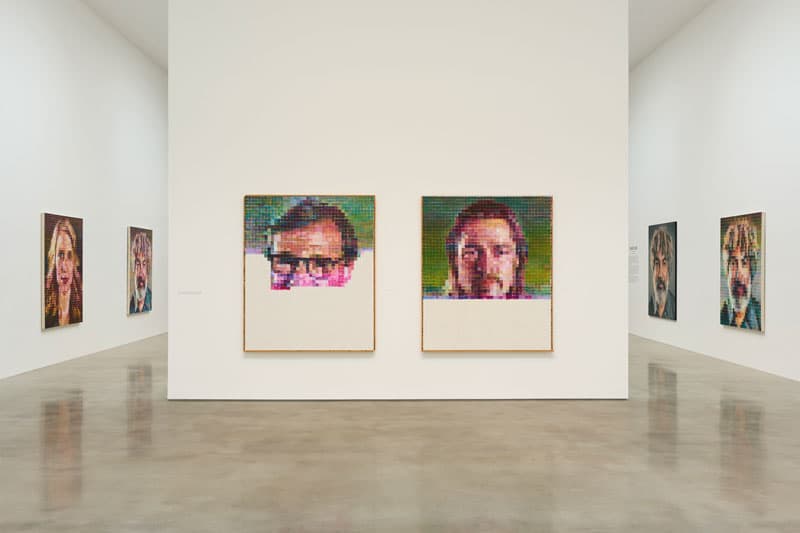
Close’s brilliant new show—his first solo exhibition since 2016— offers a plentitude of prestidigitation. Almost all the work has never been seen before, and these sixteen paintings on view (plus two watercolor separations on paper and three mosaics) are, sadly, his last. All were completed within the five years before his death in August 2021. Two of the paintings, Brad and Mike (both 2020–21), remain unfinished although with their grid-numbering in place, they look like Close simply stepped away from his easel expecting to return to complete them at any moment.

The show includes self-portraits alongside portraits of Claire Danes, Brad Pitt, Fred Wilson, and Arne Glimcher, and while color has always played a dominant role in Close’s work, these portraits are even more about color than about image. The works were created following his usual formula in which Close took a photograph (he called it his maquette), gridded it out into separate compartments, then drew a matching grid on a gigantic canvas (many of the paintings measure at least 72 by 60 inches). He then painted the individual compartments, copying one square at a time from photo to canvas. What’s new in these works is that Close, painting in incremental units, used thin layers of semi-transparent hues of red, yellow, and blue that result in jewel-like colors when layered on top of one another. (These are a printer’s colors: magenta, yellow, and cyan.) The work was created in stages using the transparent washes of oil colors that Close says he tried to treat as watercolors, overlaying the three hues in sequence and in horizontal strokes. These tone paintings result in offering an extraordinary effect. Not only is their color virtuosic, but seen from a distance, the visual data—or portrait—conveys an accurate reproduction of the subject. Yet viewed up close, we see only a set of squares in various colors, the face’s individual aspects—eyes, nose, mouth—remain unrecognizable. As the neuroscientist Barbara Knappmeyer explains in her deeply informative catalogue essay, this “flip” of perceptual experience is due to the fact that “our visual system processes faces holistically, without breaking them into their constituent parts.”

These current paintings are a far cry from the canvas that first brought Close to prominence—his photorealistic, gargantuan, black-and-white self-portrait from 1968 where we see only his head, eyes staring directly out at the viewer, face bedraggled with a cigarette hanging from the corner of his mouth: The machismo artist at work. It was the first time Close worked from a photograph and not a live model. Since then, Close’s models are not sitters, but instead, photographs, of which he is a pioneer in using as a source of imagery. As Close explained to Sherman, photography allowed him to freeze an image, flatten it out, and then study it. He has not wavered from this formula since his first giant self-portrait of 1968, and he has limited himself to mainly frontal head and shoulder views against a somewhat compressed area of a uniform background. More often than not, the viewer looks straight out at us. Close reached the grail of a signature style, as Carter Ratcliff explains in the catalogue. An unchanging format and procedure for almost fifty years, yet a continually changing way of distributing flat marks on a flat surface. In this show, the individual marks are less arbitrary and more specific in their cloisonné-like beauty. Magically, these portraits were done in only three colors: red, yellow, and blue.
Eileen Costello is a historian of modern and contemporary art and project manager of the Ellsworth Kelly catalogue raisonné.