Carmen Herrera: Paintings on Paper
Word count: 663
Paragraphs: 6

On View
Lisson GalleryPaintings on Paper
March 7–April 13, 2024
New York
“I like straight lines, I like angles, I like order,” Carmen Herrera remarked in a 1994 interview. “In this chaos that we live in, I like to put order. I guess that’s why I am a hard-edged painter, a geometric painter.” When she died in 2022, at age 106, the Cuban-born New-York-based artist left behind a legacy of a carefully calibrated singularity of vision. Her rigorous, reductive compositions typically employ only two colors and simple geometric forms—almost exclusively rectangles, triangles and trapezoids.
Within the tradition of hard-edge abstraction—from pioneers such as Malevich and Mondrian, to her contemporaries like Agnes Martin, Bridget Riley, and Ellsworth Kelly—Herrera’s contribution is distinct. In her work, she aims for a pure balance of line, form, color and structure. She focuses on achieving the maximum intensity in the compositions, and not on novel optical effects that may appear with certain contrasting color combinations—flickering after-images, for instance. Those circumstantial byproducts of the design and color, however, are certainly evident in some works, especially among the paintings on paper in this exhibition. Her forms are basically architectonic, and correspond in some way to elements of Concrete poetry. Although born in Cuba, Herrera lived in Paris and New York for most of her life. Nevertheless, rather than Minimalism, her work is more closely aligned with the revolutionary spirit of Concrete Art, Grupo Madi and other Latin American mid-twentieth-century art movements.
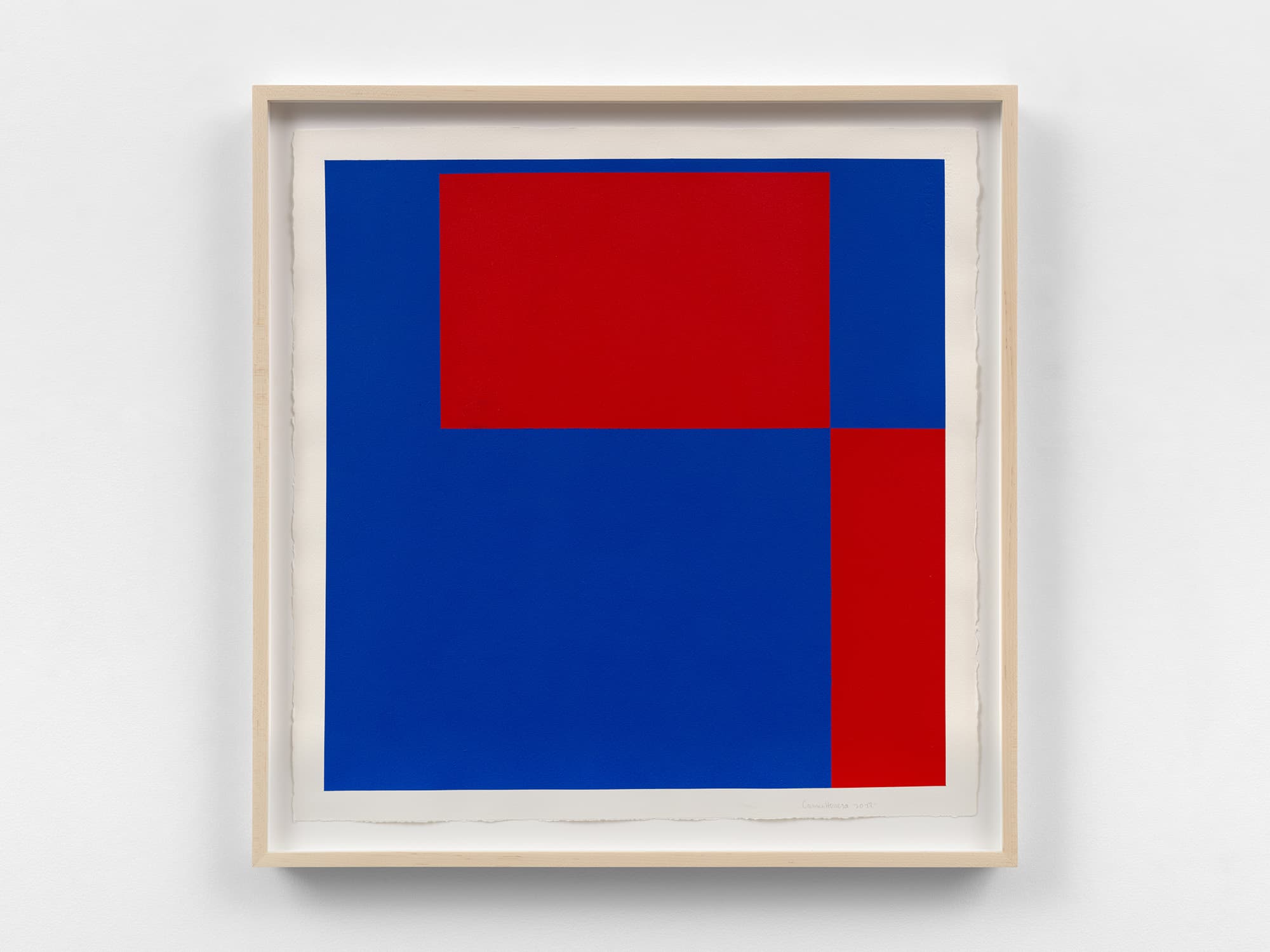
Carmen Herrera: Paintings on Paper features fifteen acrylic-on-paper compositions from 2018–22, all untitled, and most never-before shown. Making their public debut are some of the last works she produced. Like Mark Rothko’s paintings on paper, the subject of a traveling survey recently on view at the National Gallery of Art in Washington, DC, Herrera’s are not studies for canvases. They are wholly realized compositions, complete visual statements unto themselves. All of the paper paintings here are medium-size (averaging 20 by 30 inches), and most are horizontal compositions with the image precisely centered on the sheet. Colors are solid and unmodulated, using masking tape, brushes and rollers to arrive at a dense, impenetrable hue, and no gestures or signs of human touch are evident in the works.
One particularly striking example from 2012 is a bifurcated image with two narrow, tar-black, horizontal bands disrupting a blaring white plane on either side of the composition. The dark bands traverse the field toward the center in equal measure, but do not quite align. A visual tension arises in the area where the bands nearly touch, and activates the otherwise austere composition. A similarly intense interplay of forms occurs in a 2013 work in which two identical triangles in bright orange at the top and bottom of the composition, set against a deep purple background, nearly touch at an almost imperceptible center point, but remain apart. Three colors are extremely rare in Herrera’s oeuvre, and this show contains two. One piece shows a green triangle on the right, and a red triangle at the top piercing a deep blue field. The other rectangles in different tones of blue diagonally crossing a forest green field.

Also featured in the exhibition is a large, vertical canvas, Monte Verde (Cadmium) (2018), 60 by 48 inches, showing a green triangle at center set against a searing orange background. Chromatically, the painting corresponds to an 84-inch-tall minimalist-like sculpture, Tres (Orange), designed in 1971 and realized in 2019, made of aluminum painted bright orange, installed in the opposite side of the gallery space. These pieces are instrumental in exploring the relationship of the works on paper to the artist’s major canvases and 3D works, and they also underscore how the works on paper were for Herrera an equally daring, challenging and fulfilling enterprise.
David Ebony is a contributing editor of Art in America. He is also the author of monthly columns for Yale University Press online, and Artnet News.