ArtMarch 2024In Conversation
Chuck Close with Cindy Sherman

Word count: 5348
Paragraphs: 122
On View
PACERed, Yellow and Blue: The Last Paintings
February 23–April 13, 2024
New York
Those of us who are familiar with Alexis de Tocqueville’s classic volume Democracy in America (1835–40) all agree that, to this day, it remains the best book on America, as well as the best book on democracy. Among many wonderful attributes of American democracy that De Tocqueville describes are the art of association (or, in my recent rewording, “the art of joining”) as opposed to self-isolation, and “self-interest rightly understood.” To many of us, these are important reminders that it is only when we voluntarily join in association to further the interest of the group that we thereby serve, in return, our own individual interests. At the same time, knowing that such freedom is given to those who are less inclined to be natural participants in any group, we generally accept with grace the benefit from those who know how to exercise their right of joining and materialize the virtue of what they feel is right.
Chuck Close, one of our great contemporary artists, possessed naturalness and fluidity in both attributes. While he maintained the essential discipline of making his work in the private sphere, Chuck’s deep generosity in public activism on behalf of his fellow artists, from older to younger generations, is profoundly evident. He was involved many foundations and nonprofits that provided support through fellowships and studio spaces, including the Louis Comfort Tiffany Foundation, the Sharpe-Walentas Studio Program, and the President’s Committee on the Arts and Humanities, among others. No one since Chuck, beginning in 1970, has painted with such formal rigor infused with the imminent warmth of the artist’s hand on every human face. Chuck has indeed inspired endless friends and admirers who view his work as an extraordinary example of prevailing over life’s hardships, especially the aftermath of his spinal artery collapse. One beautiful summer day—July 28th, 2018—Cindy Sherman, an old friend and a recipient of several portraits Chuck made of her, and I took a trip to visit Chuck’s living and working space in Long Beach, New York. What followed was an intimate conversation between Cindy and Chuck about his life, work, and everything else in between.
—Phong H. Bui

Cindy Sherman (Rail): I should begin with one of the things that really impressed me, which was that your path to becoming an artist was affirmed by looking at a Pollock painting when you were eleven years old at the Seattle Art Museum.
Chuck Close: Yes, it was one of the early Pollocks that was given to the museum by Peggy Guggenheim (Sea Change, 1947) at the beginning of Pollock’s most iconic “drip-period” from 1947 to 1950.
Rail: And your parents were really supportive of you being an artist from the beginning?
Close: Yes, my parents thought I was the best thing that came along. My mother was a pianist and my father was an inventor, and in my family, it was better to have a creative profession than be a doctor or a lawyer or any other type of profession. I still remember the first thing I wanted to do was magic, and I still like magic partly because there’s an aspect of magic in making a painting or making art in general. I’ve never forgotten the thrilling experience around when I was eight years old of putting different colored paint on a flat surface, which instantly created an image and created space. For my fifth Christmas, the war (WWII) was still on and my dad built me a bike from scratch, but I wanted an easel so he made me an easel.
Rail: What! [Laughter.]
Close: Then what I wanted more than anything in the world was a paint set that I saw in a Sears Roebuck catalog, and I really nudged my parents, even though they didn’t have any money. But they bought me a deluxe paint set, which includes everything, oil paint tubes, brushes, paint mediums, even a paint palette.
Rail: Amazing! At that time, what was your idea of what painting meant or what being an artist was, or did you just want to play like other kids?
Close: I had lifelong neuromuscular problems so if I ran fifty feet I’d fall down. I couldn’t throw a ball, I couldn’t catch a ball.
Rail: So, you developed more creative things just because you couldn’t do sports like the other boys could.
Close: Right. My father, who worked at an Air Force base, would stop at a diner on a highway in Tacoma, Washington every day for bacon and eggs, and he died at forty-eight. Anyway, on the wall in the diner were a few paintings hanging and he asked about them. The waitress said they were painted by a woman who lived across the street so he went to her and it turned out she had studied at The Art Students’ League. […] So, I started taking lessons with her.
Rail: How old were you?
Close: I was eight, working from direct observation and drawing from nude models. It was a thrilling experience.
Rail: You were so far advanced in your training that your mentors were totally fine with that. Did you have other mentors?
Close: My parents were my first mentors so everything I did was applauded by them. I remember feeling outraged when my second-grade teacher tried to correct my drawings with objects seen in perspective, which she thought a child, especially of my age of seven or eight, couldn’t do. Later, when I was in eighth-grade, my art teacher really believed in me because of my ability to draw and paint, despite my learning disability, which in the ’40s nobody knew was diagnosed as…
Rail: Visual dyslexia.
Close: Yes. Face blindness, or prosopagnosia, was my way of feeling different and special, partly because I could draw. Friends would ask me to draw a B-38 plane and I’d draw them one and they’d say “wow.” I’ve been trying to get that “wow” ever since. What about you? Were your parents supportive of your interest in art early on?

Rail: My parents were not at all interested in going to museums. I don’t think I went to a museum until I was in Buffalo State College.
Close: Where you studied painting, at least in the beginning.
Rail: That’s right. It was in 1972. I do still remember we had one or two art books in the house, one from Time Life’s Library of Art series, maybe it was The World of Rembrandt, and a book on (Salvador) Dalí, with a lavish reproduction of The Sacrament of the Last Supper (1955). I got into playing with paint because my older siblings had left some paints and pastels around and so I would just sit in front of the TV and doodle. I’m jealous that you were so nurtured and encouraged and at such a young age.
Close: Since I couldn’t do anything else, I put all my eggs in one basket, which in some ways makes life a lot easier. It’s harder when you have so many skills, trying to figure out what you most want to do.
Rail: I’m curious about the face blindness. How early did you realize that it was an abnormal condition?
Close: As early as in kindergarten because I couldn’t remember which kids were in my class or in the other class, and by the end of the year I still didn’t know or remember their names.
Rail: So, listening to somebody’s voice may help you to identify who they are?
Close: It’s curious, to this day I recognize people more by their gait, by the way they walk than other aspects of their physiognomy. In high school I used to make caricatures of all the teachers, so I eventually learned that a caricature accentuates features and looks more like a person than a regular drawing does.
Rail: So, looking at somebody’s face in person won’t help your facial recognition, but if it’s a picture, either a painting or a photograph, of a face that’s okay.
Close: Yes, because in either case it’s a flat image, which is how I correspond to his or her face to their name. This is the sole reason why I’ve worked from photography from the very beginning. In other words, if you move your head one-quarter of an inch to me it’s a whole new head, so photography allowed me to freeze an image, flatten it out, and then I could study it. If it hadn’t been for photography I don’t think I would be a very interesting painter.
Rail: Say you’re taking many Polaroids, say ten of the sitter, does each one look like a different person to you?
Close: No, only the one I choose to paint will be identified with the sitter.
Rail:Because you just memorize the one image that you’re painting?
Close: Yeah, only after having scrutinized it over and over and over again a thousand times as a way of committing it to memory will I cement who he or she is in my psyche. So, for example, having painted you twice in 1988, you are a part of my—
Rail: Your repertoire.
Close: That’s right; people I know well from having painted them.
Rail: But when you do look at a specific person’s face in person you’re not saying, “Oh, I recognize that specific corner of your forehead from that particular color.” Or, you won’t have to go back to the photograph you took of the sitter before recognizing him or her.
Close: No. Though if the image is of a person I see many times repeatedly in a newspaper or on TV—like I remember being at one of your Christmas parties several years ago, Monica Lewinsky was there and I said, “Wow, this woman really looks familiar.” [Laughter.] And, you know, I couldn’t peel back the layers.
Rail: She’s a beauty and an interesting person. You should paint her.
Close: A very smart person for sure.
Rail: And she did a great TED Talk (The Price of Shame, March 20, 2015) about being one of the first casualties from cyberbullying well before cyberbullying became a term. She was just bullied by the media, yet has found ways to survive with dignity. She’s great.
Close: I have tremendous respect for her. What about you? When did you make the transition from painting and drawing to photography?
Rail: It was in college when I was taking introductory painting, printmaking, sculpture, and photography courses—and maybe something else too. And I failed the Introduction to Photography course so I had to retake it. And the reason I failed it was because I couldn’t get all of the technical procedures processed, from the chemicals and the zone system and overexposed, underdeveloped, to “dodging,” “burning,” or whatever was required in the darkroom. It was a nightmare. Luckily, the teacher I had the next year said, “just don’t worry about all that stuff, concentrate on the ideas that you’re excited about,” and I guess it was right around this time I was also learning about conceptual art, minimalist art, performance art, and so on.
Close: Did you like being and working in the dark room?
Rail: I did. I liked the magic of it, especially putting an Ilford RC paper, after it was exposed, into the tray of developer, then gently rocking the solution back and forth, then doing the same with the stop bath…
Close: Then water … fantastic, isn’t it? Every time I see the image developing, it blows my mind all over again. But you know young artists today don’t know anything about wet printing. It’s all digital.
Rail: I know, it’s sad.
Close: I used to love dodging and burning and all of those magical things in various shades of darkness, getting them into the dialogue with various shades of light, which essentially was the challenge at the time. But after having worked with black and white, I realized the same was applied to color transparency. I worked with dye transfers which are red, blue, and yellow and that way I would print out just the magenta, just the cyan, magenta plus the cyan, yellow, and—
Rail: All three together.
Close: I remember being blown away by your work the moment I saw it at your first show at Metro Pictures, which must have been in 1980. I immediately bought a piece from that show.
Rail: It was definitely the first time anybody I knew and respected and was in awe of bought a piece of mine, so I was just thrilled. I remember Helene (Winer) telling me, “Chuck Close came in today and really liked your work.” It meant so much to me.
Close: But I remember you and your work in a group show at Artists Space earlier, maybe in 1978 (along with Louise Lawler and Adrian Piper, organized by Janelle Reiring).
Rail: Artists Space, right. We’ve been around, we’ve both been around. [Laughter.] And you come from such an amazing group of artists from Yale, and it’s amazing that you all have managed to stay friends.
Close: Coming up when we did in the late ’60s, all of our heroes didn’t even start showing art until their forties like De Kooning who had his first solo show at Charles Egan in 1948 when he was 42 years old for example, so we felt we had our whole life to figure out what we were doing, and none of us were and are doing anything remotely resembling what we did in graduate school. Now, not only are the collectors going to graduate school to buy art, they’re going to undergraduate schools. There's no time to fail or fall flat on your face. I’m not so sure it’s healthy for the artists in a long run.
Rail: I think there’s something so surreal about it all. I mean, we both managed to be artists in spite of you having gone to a famous graduate school, and I as an undergraduate to a state college, which was and still is barely considered an art school.
Close: Yet there were you, Robert Longo, Charles Clough, Nancy Dwyer, and a few others who founded Hallwalls Contemporary Art Center.
Rail: Hallwalls, yeah. I was lucky that I met a group of artists, and we all wanted to create an alternative gallery, but I guess for you and for most young artists today the idea of going to graduate school and getting an MFA is that you get more of a tutorial, one-on-one with professional artists/professors. Is that true?
Close: Well most of the professional artists/professors are used to talking about art, and the idea is you talk about art before you make art and all of us who went to Yale could really talk about art. You had to be able to do that. But nothing that you learn in school is ever valuable later so I just think it’s a question of work habits and being able to find what you need to know when you need to know it, among other things…
Rail: Especially when you’re in the community of artist friends who share similar struggles and are trying to grow.
Close: We all helped each other. Absolutely. I never forget on the same day I photographed Richard (Serra), Phil (Philip Glass), and Nancy (Graves) because I wanted to shoot anonymous people, ordinary people, so I invited them, my friends, and then they all became famous. [Laughter.] Phil said all he had to do was show up that day and his career was off and running.

Rail: It was like being blessed. How did you and Phil meet?
Close: I met Phil in Paris through Richard and Nancy in either late 1964 or early 1965. There were seven of us that got Fulbright so we would just travel around and visit each other. Nancy got the Fulbright and Richard got the Yale Traveling Fellowship and the next year Richard got a Fulbright to Italy and I visited him there also.
Rail: Why was Phil living in Paris at the time?
Close: He was studying composition with the legendary Nadia Boulanger, also on a Fulbright. You can say that we all acquired good skills, though as far as work habits, survival, and anything in between that generates a career, we each had to acquire them on our own.
Rail: So, unlike the ’80s, the decade I grew up in, which was just so overhyped and overpriced and the beginning of everybody wanting to be an artist just to make money and to go to graduate school just because then they’d get the connections and get a show right out of school.
Close: I had an opportunity to show out of graduate school and I didn’t do it because I knew that once you go public with something you’re responsible for it forever, and I knew I wasn’t there yet.
Rail: That was smart of you.
Close: It was self-preservation, once you go public.
Rail: That’s what you’re known for, and you’ll be reduced and identified to what you make.
Close: But with a few exceptions, I always thought, for example, “Wow, Gerhard Richter is so smart, he found two ways to work.” Why didn’t I do that?
Rail: Yeah, and nobody questions him.

Close: But you are the only member of your generation who never suffered a decline.
Rail: I’m lucky I guess. Knock on wood.
Close: The thing is, your work has always progressed, no matter what.
Rail: Yeah, I get bored too easily with what I’m doing so that’s why I work serially, just so that once I’m done with one specific series, I need to move on to the next.
Close: Me too. Except a series in my case can take ten years. [Laughter.] Still, within your exploration of serial form, it was an occasional surprise when people got confused or were shocked with how you used medical mannequins, mutilated dolls, or crazy-looking masks, arranged in those insane configurations.
Rail: Well, there were the medical mannequins and then the cut-up dolls, and then I did these weird still lives with spilled food, vomit, etc. I always found that once I’ve done something that’s successful, it frees me up to be much more experimental, more playful with what an artist is expected to do next. And I do feel like I have been fortunate, I guess if you will, to make mistakes. And I think artists shouldn’t be afraid of making mistakes in their art because you learn from it and it doesn’t mean that it’s necessarily bad by making mistakes, it’s educational even to share mistakes with others. So, I always found the value of taking a chance and being experimental.
Close: I’ve been criticized for having made a lot of self-portraits as if it’s a form of narcissism. And I was thinking … “What about Cindy?” But the secret is that you’re a different person in each piece.
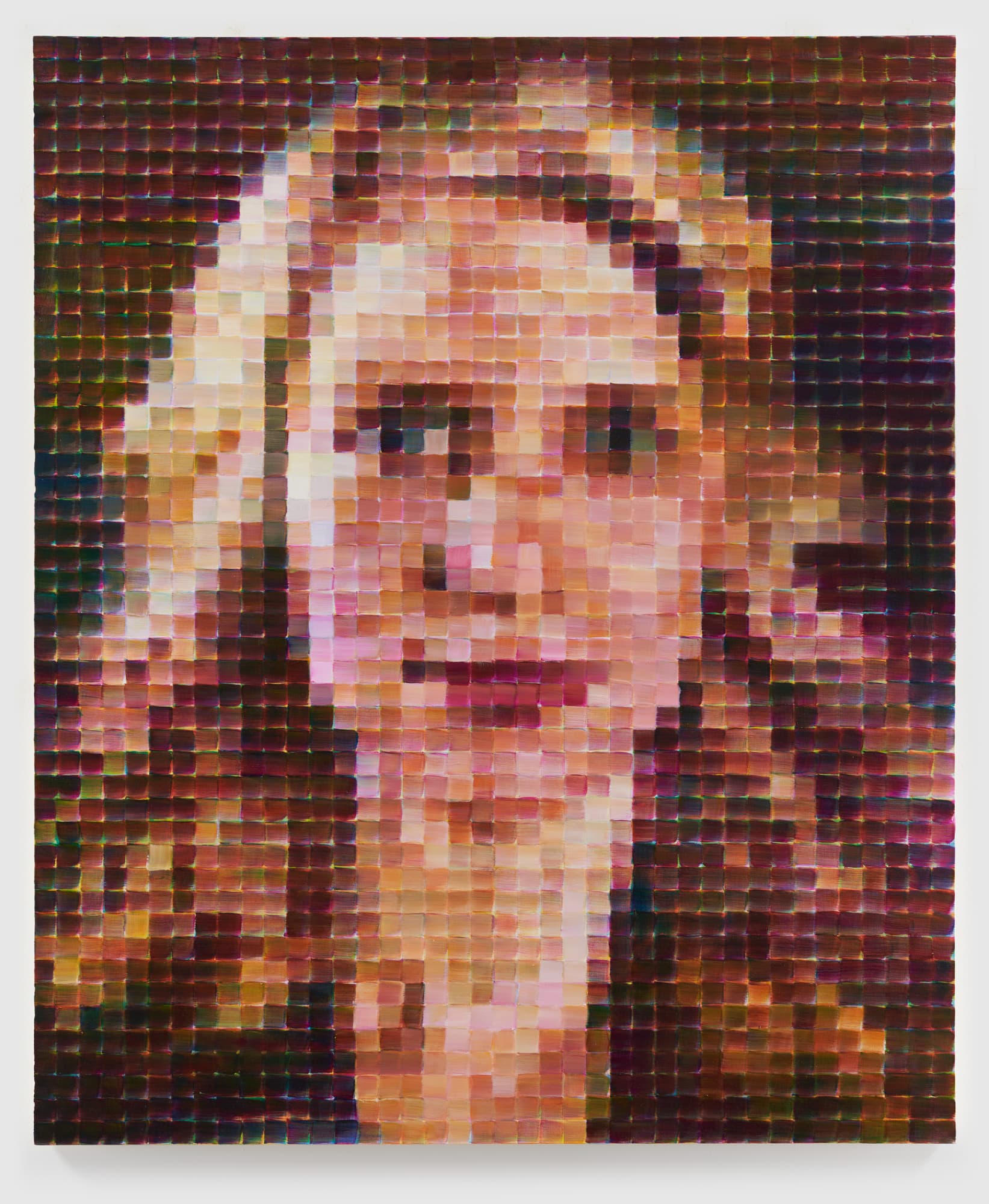
Rail: Right, because I see it, or at least it has been pointed out to me, that I’m an actor who just plays a lot of different roles. But in your work, it’s so abstract up close, in different ways. Each is an exercise of its own subtle repetition of colorful little blobs or brushstrokes within each square in the grid. It’s only when you view it from a distance that you recognize a face of someone.
Close: Every painting I’ve made since 1967 has been made with a grid, although for a long time you didn’t see the grid. And then at a certain point, I made a mezzotint and I scratched the lines right in the plate and there they were, the incremental units. I thought they were interesting in that I could apply them incrementally with all kinds of materials, fingerprints, pulp paper, and eventually even making tapestries. It’s a grid.
Rail: Chuck, I also read something that said your work with airbrushing paved the way for the inkjet printer.

Close: At MIT they actually called it the Chuck Close program because they use little images that make big ones. Someone that knew what I did says it predates the pixel. They claim that I predated the inkjet because I use an airbrush to blow the pigments one at a time and they form full color magenta, cyan, yellow. Technology has played such a role in our lives; it’s kind of nice when it serves the handmade, where the touch is revealed on the surface of the object.
Rail: Would you explain the difference between a regular Dobby loom and a Jacquard loom?
Close: The difference between the Jacquard and Dobby looms is how the long, vertical warp yarns move up and down while the horizontal weft yarn is passing through back and forth, which creates a pattern. And whereas a Dobby loom is best used for simple patterns because of the limitations of the harnesses, the Jacquard loom harnesses are connected to not just one, two, but sometimes four warp yarns. Each one of those warp yarns can be moved individually, which is what allows much more complex, intricate patterns to be woven.
Rail: Right. And of course, one is hand operated and the other mechanized.
Close: If you look at the back of my tapestries it sometimes looks like a negative. The first things I made were made in China.
Rail: How?
Close: Sol and Carol LeWitt were among the very first group of American artists that were allowed into China in the early ’80s and they brought back these tapestries of Mao’s portraits, which evidently Mao had a million made, along with Lenin, Trotsky, Stalin, and then he had all looms destroyed. I had a friend who went to this factory and they said “in the Cultural Revolution it was forbidden to make anything else but propaganda images, and the Communist government destroyed all the looms at a certain point. We could make it again, but it’s going to cost a lot of money.” It went up $2,000. So the first image after Mao was Philip Glass.
Rail: That’s amazing. [Laughs.] That was done more traditionally where it’s literally hand-woven.
Close: I did an edition of ten rugs and they set up five looms and five different people made them and then they did them again. So they’re all a little bit different because each person has a different touch, every time he or she tries to replicate what was done prior. It was very interesting.
Rail: Which is perfect to your process.
Close: Plus, the thing that I like about photography and prints is that I can go through a series quickly and my paintings take so damn long. And the idea of working with someone who is an expert in the field is pretty interesting too. I can see what they do, I can change it, I can make corrections.

Rail: The same can be said of the subtle change in depiction from tapestries to mosaics, except for the big change in materials—I mean your twelve large-scale subway portrait commissions for the 86th Street station; the tiles look very textured, and have different material pressure altogether.
Close: Again, I try to do each one with a different approach, with how the image is put together, which the MTA has accepted. I did some drawings that were felt stamp pieces and when tiled together, they interpreted them as a bunch of circles, which were made in an incredibly interesting and complicated way. They have to manufacture every piece, glaze it, fire it.
Rail: Talking to you now reminds me how photography for the longest time was not respected. And while you were at some panel discussions or conferences…
Close: Oh God, I got spit on at a Figurative Art Alliance event, probably in 1971. At the time, if you worked from a photograph—it was the devil’s work. My good friend Philip Pearlstein wrote this big article, Why I Paint the Way I Do for the New York Times, “I get my highs from using my eyes,” he wrote in one passage. And I thought, well does that mean I’m not looking and using my eyes? It was a real strong prejudice.
Rail: Just because you were using photography? That’s crazy.
Close: I know. Just to change the subject: you gave me a photograph of your studio—where the magic happens, setting the stage with props, manipulating lighting situations, make-up, hairstyling, etc. etc.
Rail: It changes all the time depending on the series I’m working on, especially the character I’m trying to depict.
Close: Do you feel at times you’re performing like things we see on TV?
Rail: Kind of, yes.
Close: You’re the weatherman. [Laughter.] The level of artificiality with the reality of the image is really interesting.
Rail: I know you talk about that a lot in your own work as well—reality and artificiality.
Close: But you’re giving the viewers more hints about how they’re made than previously anticipated. No?
Rail: Yeah, I guess. I used to care about the fact that if I recognized myself too much or saw too much of myself in the image that it wasn’t a successful image, but now I don’t see it that way.
Close: I don’t have much control because I have Frontotemporal dementia.
Rail: What is Frontotemporal dementia? And what are the symptoms?
Close: It’s a disorder caused by progressive nerve cell loss in the brain’s frontal lobes (the area behind your forehead) or its temporal lobes (the regions behind your ears). The symptoms include deterioration in behavior and personality, alterations in muscle or motor functions, or language disturbances, but the progress is very slow.
Rail: Oh dear! What’s your work routine?
Close: I like to work for three hours in the morning, break an hour for lunch, then I work another three hours in the afternoon. If I work more than that I really start screwing up things. How about you?
Rail: It’s very sporadic for me. Usually I’ll do appointments, go to the gym, or check emails and stuff like that in the early part of the day, and then about two o’clock, sort of after lunch, is when I really start. So I’m usually not very social when I’m shooting because I work into the evening and sometimes—when I was younger I used to work until, you know, three o’clock in the morning, but now I work until nine, nine-thirty at the latest.
Close: I remember working all night long. It was great, wasn’t it? Momentum.

Rail: Yeah, momentum, and youth. Actually, ever since I’ve started shooting digitally, I can see the results right away, which is great because I can made readjustments, changing the wig, re-shooting things, whereas in the past I would shoot one or two rolls of film and then take all the makeup off and take the film to the lab and then wait while that was being developed and usually that was one day, and then the next day if I had to reshoot anything, redo all the makeup all over again. It just means with all these conveniences I tend to work a longer day.
Close: Digital technology really has changed everything.
Rail: It’s much easier for me. What about you?
Close: First I take the Polaroid, the Polaroids are scanned, they get sent to Don in Oakland who would work with me to breakdown the separations of a painting say of fifty-thousand brush strokes.
Rail: Wow, that’s a lot of brushstrokes.
Close: And it takes countless digital corrections [all the separations] before I can paint them. As you know, I only work on one painting at a time. Those who have seen these new paintings of Fred, all said they are far more abstract than anything I’ve painted in the past, which in some ways is true simply because it’s only when you take a photo of the painting with your smart phone will you see the realism of Fred’s face. It’s a total abstraction made up of different layers of thinly painted oil colors on top of another within the grid. Everyone asked me whether it was intentional, and I said no! It was a total surprise.
Rail: Like how you describe art as magic when you were a little kid.
Close: Exactly! My friend Paul Simon and I often have endless conversations about the similarities between painting and songwriting in that the subject of the face in my painting from afar is perfectly recognizable, but inches away the face dissolves into a mosaic of identical squares within a grid that incrementally build up the total image—the same way when you look at a composer’s score, it’s just a bunch of marks. Any song can be broken down into innumerable phrases, notes and chords that correspond to lyrics, which are made up by words and letters. But yes, this new body of work is more abstract, and quiet than any previous ones, the brush strokes don’t make shapes or stand for any particular information per se, they just exist as layers of transparent washes of oil colors that I’m trying to treat as watercolors, as I did decades ago.
It feels like a new beginning.
Suggested Reading: Chuck Close In Conversation with Phong H. Bui
Cindy Sherman is an artist.