Mood of the moment: Gaby Aghion and the house of Chloé
Word count: 963
Paragraphs: 7
On View
Jewish MuseumMood of the moment: Gaby Aghion and the house of Chloé
October 13, 2023–February 18, 2024
New York
T-shirts emblazoned with graphics of shrimp and studded handbags find their place amongst thousands of years of Judaica at the Jewish Museum’s latest show. Their introduction to the space is not an act of sacrilege but rather a dynamic curatorial choice in the new exhibition Mood of the moment: Gaby Aghion and the house of Chloé.
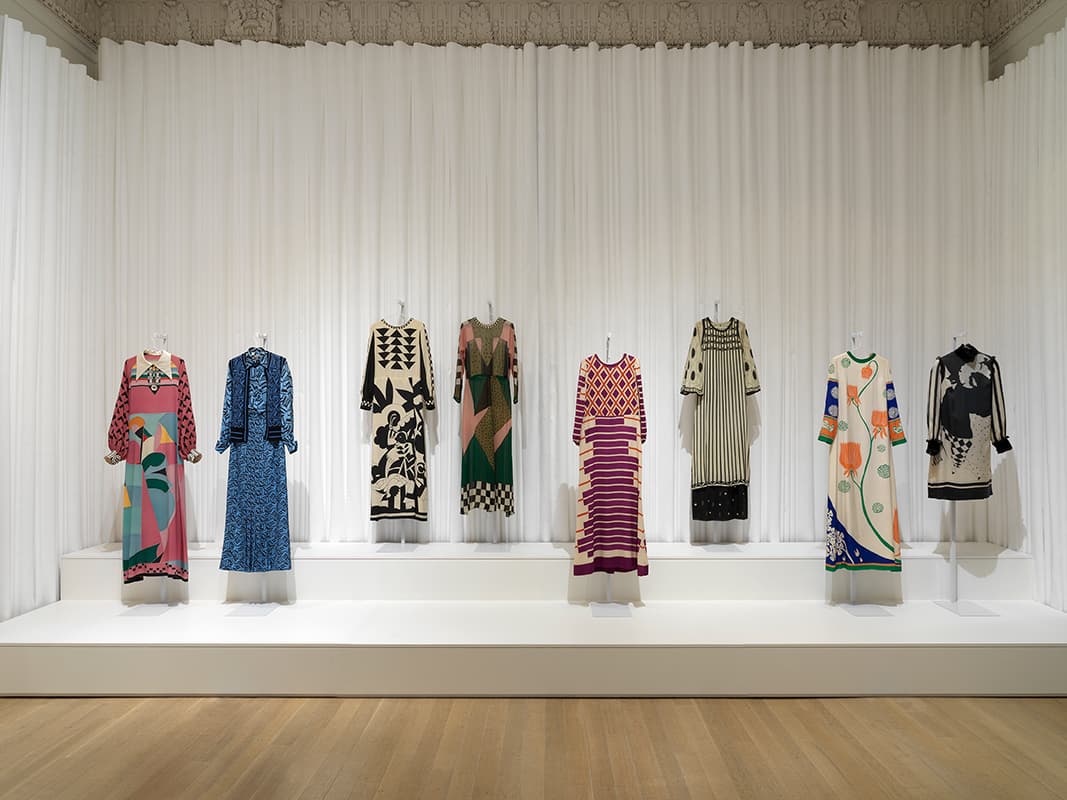
Mood of the moment is only the second fashion exhibition mounted by the museum in its 119-year history and one of the first exhibitions ever dedicated solely to major French fashion label Chloé. The show is not defined, however, by a spirit of newness in the way that blockbuster exhibitions of designer compatriots like Dior and Chanel often are, lush with customised mannequins, LED lighting displays, and social media-friendly photo opportunities. Mood of the moment instead takes a gentle approach, walking through seventy years of Chloé’s history in a linear manner, refusing to lend too much subjective fanfare to any specific moment in the brand’s past. Curator (and Brooklyn Rail contributor) Choghakate Kazarian provides a tightly-edited selection of work from each designer who contributed to the house, creating an exhibition that shows an abundance of beauty while sparing visitors a sense of visual overwhelm. Garments are displayed from wire hangers and simple dress forms, or, at times, casually draped over the hangers as if freshly discarded from a day of wear. The result is an exhibition that feels refreshing and almost radically understated.

At times, this lack of fanfare is almost Mood of the moment’s downfall. Ostensibly the show is about Gaby Aghion, founder of Chloé. On paper, Aghion’s identity is complex: Jewish, French-Egyptian, Communist, and female. But in the materials provided by the Jewish Museum, her story feels simpler. She is painted as a wealthy woman who married a wealthy man and used her shrewd business acumen to achieve success.This is true—Aghion had good taste and the admirable foresight to build her label on what she thought might have lasting appeal to consumers: wearable separates made by a rotating cast of young designers, easily recognisable branding, and clothes that could be carried out of the store just after purchase, a real innovation at the time of Chloé’s launch in 1952. In fact, some credit Aghion with being the first to use the term prêt-a-porter or “ready-to-wear” to describe her clothing. After these contributions are listed, though, Aghion essentially disappears from the exhibition, as any discussion of her time at Chloé is set aside in favour of a tour through the designers who led the house after her departure. However, if audiences are meant to make up their own minds about Aghion’s legacy, a paltry paragraph of wall text about her young adulthood in Egypt may not provide sufficient food for thought.
There is similarly little guidance on the part of the museum when the great problem of Karl Lagerfeld once again rears its head. Lagerfeld spent two decades working alongside Aghion at Chloé in its early years, and he returned as creative director from 1992 to 1997 after Aghion sold the brand. The Jewish Museum chooses to acknowledge the fact that Lagerfeld’s family held direct ties to the Nazi party and that Lagerfeld himself was a known anti-Semite. The question of what to do with this truth is a tricky one, as proven by the Metropolitan Museum of Art’s Karl Lagerfeld: A Line of Beauty exhibition, and the question becomes even trickier when Lagerfeld’s work is placed in an explicitly Jewish setting. The Jewish Museum’s decision to follow this caveat with a room of the most exciting and heavily embellished dresses Lagerfeld designed for Chloé creates a sense of unease within the exhibition. Is his place in the house’s history one to be revered or an unfortunate stain?

After the Lagerfeld years, the relative quietude of the Jewish Museum works beautifully to tell the story of Chloé. A collection of t-shirts from Stella McCartney and Phoebe Philo’s respective tenures at the house between 1997 and 2006 are placed just beside corset-boned dresses and diaphanous chiffon gowns by the same designers, a subtle commentary on the ways in which women’s fashion has transformed since Aghion first envisioned ready-to-wear. The shared language of the female designers who have helmed Chloé after Aghion—McCartney, Philo, Clare Waight Keller, and Gabriela Hearst—is made visible in the tightly curated selection of their garments. All feature horse motifs, shades of beige, and scalloped seams, and yet this similarity is never laid out as an explicit characteristic of their work. The result is akin to overhearing a whispered conversation among these women, their unique philosophies on design just barely intimated beneath the clothing on display.
Mood of the moment culminates in a room of sand-colored blouses from every era of the house’s history hung from floor to ceiling, a pared-down version of the majestic dress displays that have become de rigueur as finales at institutions like the Costume Institute and the Brooklyn Museum. It recalls a statement from Aghion printed at the entrance to the show: “I started Chloé because I loved the idea of couture, but found the concept a little out of date—a little artificial. A thing of beauty and quality should be seen on women in the streets.” When watching these blouses gently swing from the no-frills wire hangers on which they are displayed, Aghion’s voice hardly feels out of reach. It is right there, ready to be worn.
Ruby Redstone is a fashion historian and contemporary fashion writer. Her work has been featured in Vogue, Harper’s Bazaar, and New York Magazine, and within her own monthly newsletter Old Fashioned, which examines the intersection of fashion history and personal style. Ms. Redstone holds an MA in Fashion History from the Courtauld Institute of Art and an MA in the History of Art from the University of Saint Andrews.