Ad Reinhardt
Word count: 777
Paragraphs: 7
On View
David ZwirnerAd Reinhardt
November 1, 2023–January 27, 2024
New York
In looking at Ad Reinhardt at work on an unfinished black painting in one of John Leongard’s 1966 photographs of the artist in his 732 Broadway studio one notices in the still wet paint evidence of the rhythmic application and uneven reflection as it is spread across the canvas surface. In the finished black paintings the movement of Reinhardt’s brush strokes are no longer visible. Before 1954, the year Reinhardt decided to only make black paintings, there are many paintings that retain the visible making and varied surface effects of each painting’s progress toward completion, though this term in the works from the 1940s remained a relative term then.
By this, I mean that through this decade, given that Reinhardt made very few sales, most paintings remained in his studio, available for further reworking if necessary or for continued exploration if desired. And, these paintings, some never exhibited before, make clear—because of the recursive experimentation—that a chronology is not always obvious. In working toward the “indefinable thing” of pure aesthetic communication, Reinhardt felt that he needed to “get rid of” everything that inhibited or obscured this.
During the 1940s in New York City the audience for abstract painting was comprised mostly of other artists. Artists could explore without the attention of the now familiar, extensive art world characterized by its attendant critical proscriptions and career competitions. Reinhardt worked through many possibilities of abstraction, including “breaking up geometry” at times literally scratching through surfaces or erasing surfaces under a faucet as well as covering and obliterating already existing layers with still more paint. European artists such as Paul Klee and Piet Mondrian, who had also used the geometry of the grid for different purposes, must have informed Reinhardt’s thinking.
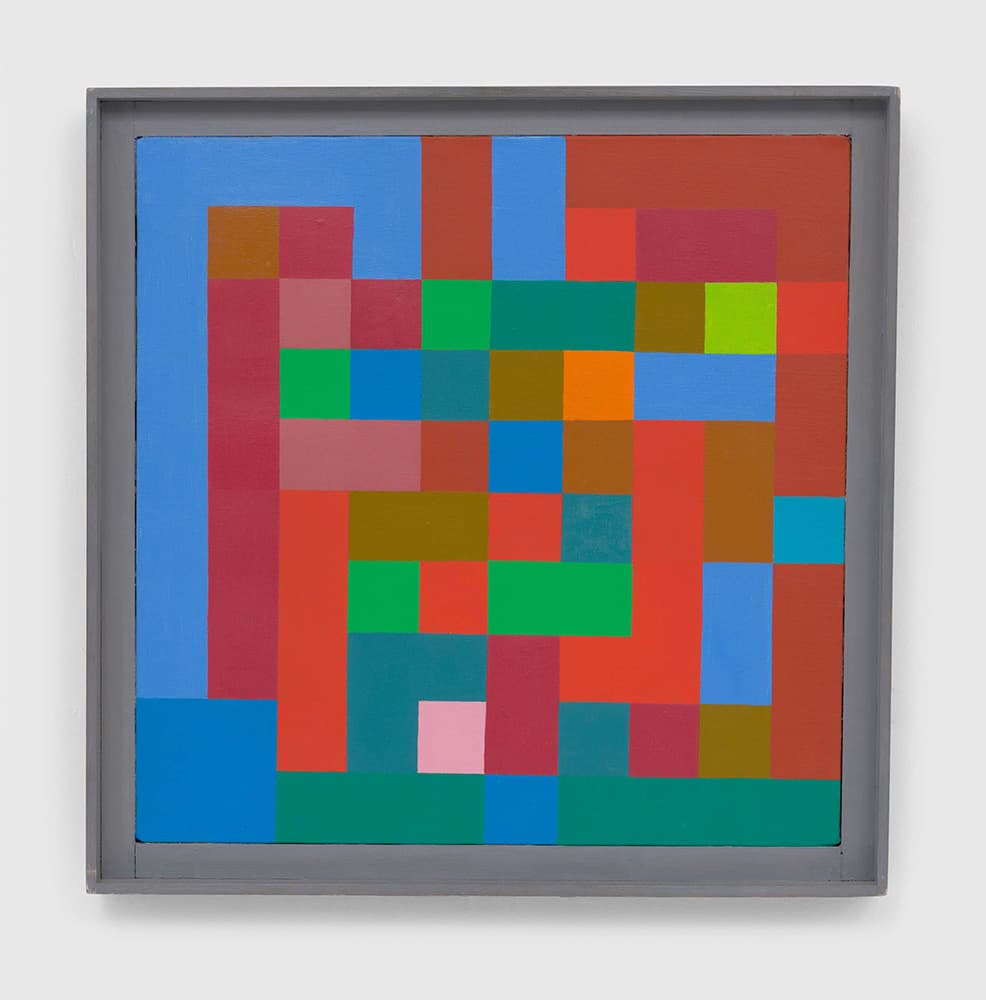
The installation of works in this town house gallery—of many different sizes, proportions, and in a variety of mediums and on different supports—placed over fire places, across from viewing benches, and together with a beautiful parquet floor, and decorative wall moldings—suits the experience of these exploratory works that link the first half of the last century with what followed when abstraction became accepted as the preeminent modernist style. Take for example two paintings, Abstract Painting (1940) and Untitled (c. 1940) both oil on canvas. The division into repeated squares and rectangles of flat, contrasting and close toned color is not only prescient of Reinhardt’s later works, and much of minimalist or pop painting that was to be widespread by the 1970s, but also looked back to earlier works such as those by Josef Albers, or again Klee and Mondrian.

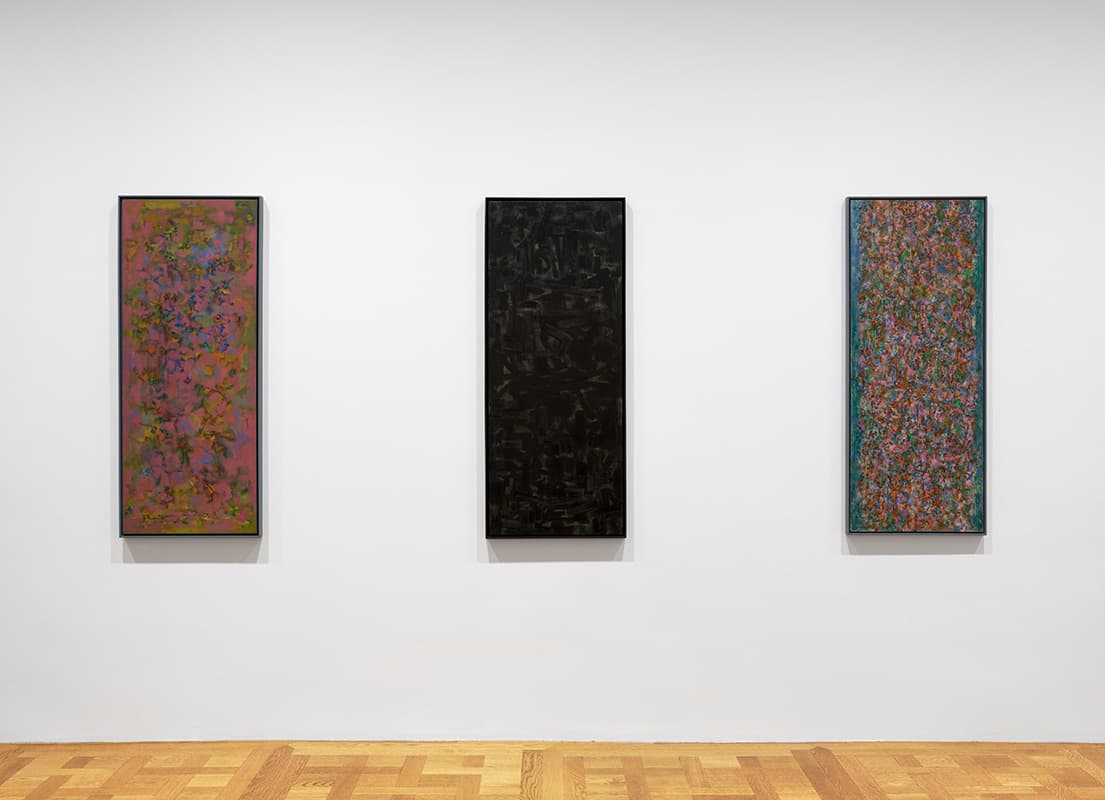
Abstract Painting (1948), is a vertical, oil on canvas. The surface of the canvas partially absorbs the short strokes of a loaded brush as the canvas is not primed, and leaves the glossy shine of black paint—it looks like enamel rather than oil color—elsewhere on the canvas. There is an allover field of interlocking strokes and stains, somewhat like Jackson Pollock’s very last paintings. Reinhardt studied Chinese scroll paintings in 1943 and would make many paintings in this narrow vertical format. To add to the openness of process, some of the paintings in this format and others have up to three arrows on the reverse, indicating a willingness to hang the painting in other orientations; sometimes if a painting didn’t fit a wall vertically, it would be hung horizontally. Untitled (1941), a gouache on board, is vibrantly worked, and increases the speed of mark to an iterated, scratched, and drawn accumulation—building the image and obscuring it as in a drawing, recalling a Willem de Kooning painting or drawing.
Reinhardt’s idea that the work of art can communicate directly, and not depend on intellectual, spiritual, or mystical values, does not exclude these values for the viewer, or the artist—it just excludes them as justification for the work itself. Reinhardt said all the early work he saved “looked black to him,” in other words, like pure aesthetic experience, as this is what black meant to him. Here is Clement Greenberg in conversation with Thierry de Duve in 1987: “Art as Idea is for those who don’t ask enough from art, don’t ask enough of art, don’t ask for truly aesthetic experience but rather for something classifiable, identifiable as new, and new on the instant.” As much as Ad Reinhardt often disagreed with critics’ statements, I think he would have agreed with this.
David Rhodes is a New York-based artist and writer, originally from Manchester, UK.