Listening to the Play: Arin Arbus on Directing Waiting for Godot

Word count: 1163
Paragraphs: 12
Waiting For Godot
November 4–December 3, 2023
Brooklyn
Seventy years after its Paris premiere at Théâtre de Babylone and sixty-eight years since the first English-language production in London, Samuel Beckett’s Waiting for Godot takes the stage November 4 at Theatre for a New Audience (TFANA) in Brooklyn with a stellar cast (Michael Shannon as Estragon, Paul Sparks as Vladimir, Toussaint Francois Battiste as a boy, Jeff Biehl as Lucky, and Ajay Naidu as Pozzo).
“The reason to do it is the way that it resonates in this moment and to do it with the people in the room,” director Arin Arbus said, though she recognized that it’s “rare that there’s a strong production” of Godot. Now, she’s wrestling with this staple of absurdist playwriting, often associated with French existentialism, though the openness of the text has encouraged highly varied interpretations. There have even been riffs on it: Antoinette Chinonye Nwandu’s Pass Over on Broadway in 2021—which Arbus said she saw and thought “an amazing, wonderful play”—borrows some Godot elements and puts them in conversation with the Black Lives Matter movement.
Arbus, forty-four, who lives in Brooklyn with her three-year-old daughter, first became associated with TFANA in 2007 and is now a resident director there. She said that the spark for the Godot project came from “Michael and Paul, who have an amazing working history together,” including their last show at TFANA, The Killer, in 2014. They are “pals in real life and have worked together a lot through the years. It was a great way to start a production of Godot because you can’t fake that relationship between Didi and Gogo. Without believing in their connection, the play means less.”
Asked about the continuing relevance of a no longer avant-garde seventy-year-old play by a dead white heterosexual Western European male writer in the current theater climate with its attention to inclusion and identity, Arbus responded that “the play is always about now” and that “the experience of watching it remains startling.” She countered that she has “spent a lot of time interpreting old plays,” such as her several Shakespeare productions, which have been widely lauded for their clarity. Recent plays have been met with similar success: her 2017 production of Thornton Wilder’s The Skin of Our Teeth at TFANA won her an Obie, and she made her Broadway debut directing Terrence McNally’s Frankie and Johnny in the Clair de Lune, which co-starred Shannon.
When pressed about the play’s association with existentialism, she was wary: “I don’t think about it that way. That pins me to something that I’d like to resist.” She continued that she wasn’t “walking into rehearsal with a philosophy in my pocket.” As to the recurrent Christian references: “I don’t know what we’ll do with it, how we’ll play it.” She added, “Didi and Gogo are two confused suffering homeless souls trying to make sense of their situation and they can’t.” They are “grasping at things that people throughout history have grasped at. Is it comforting? Does it get them anywhere? Religion offers nothing to them.” Asked who is Godot, she replied, laughing, “I’m not going to answer that question.”
While on another occasion she said that her entry into a play was through a character, here the connection was couples dynamics. “The play is about couples, even the boy and his brother. We’re all Didi or Gogo. We’ve all been Lucky, and we’ve all been Pozzo. We’ve held the rope in relationships.” She believes that in the play “the relationships are more clearly drawn than the characters themselves.” She thought that there was common ground in the experience of “being with someone and wanting to be away.” In the end, “they are who they are only because they’re not the other one,” she said. In Godot, she conceded, the couple’s dynamic is pushed to the extreme, with the master/slave relationship between Pozzo and Lucky. She pointed out that in his lifetime Beckett had witnessed extreme cruelty and friends marching to war and their death. “They are everywhere around us, those types of relationships,” she said, whether in a concentration camp or in a marriage.
Arbus calls her artistic approach to directing “text-based and collaborative,” in which her main goal is “trying to listen to the play.”
“What we can come up with together is more exciting than what I can come up with by myself,” she said. She does not have a theory of acting, such as Meisner or Stanislavski: “I wish I did.” (Tangentially, she noted that her parents Mariclare Costello and Allan Arbus, who remained together for fifty years, met in an acting class.) She explained that “different actors need different things. You have to meet them in the middle.” She protested that “sometimes I get accused of having no interpretation. That’s not true. But I’m not a director who comes in and says I know all the answers.”
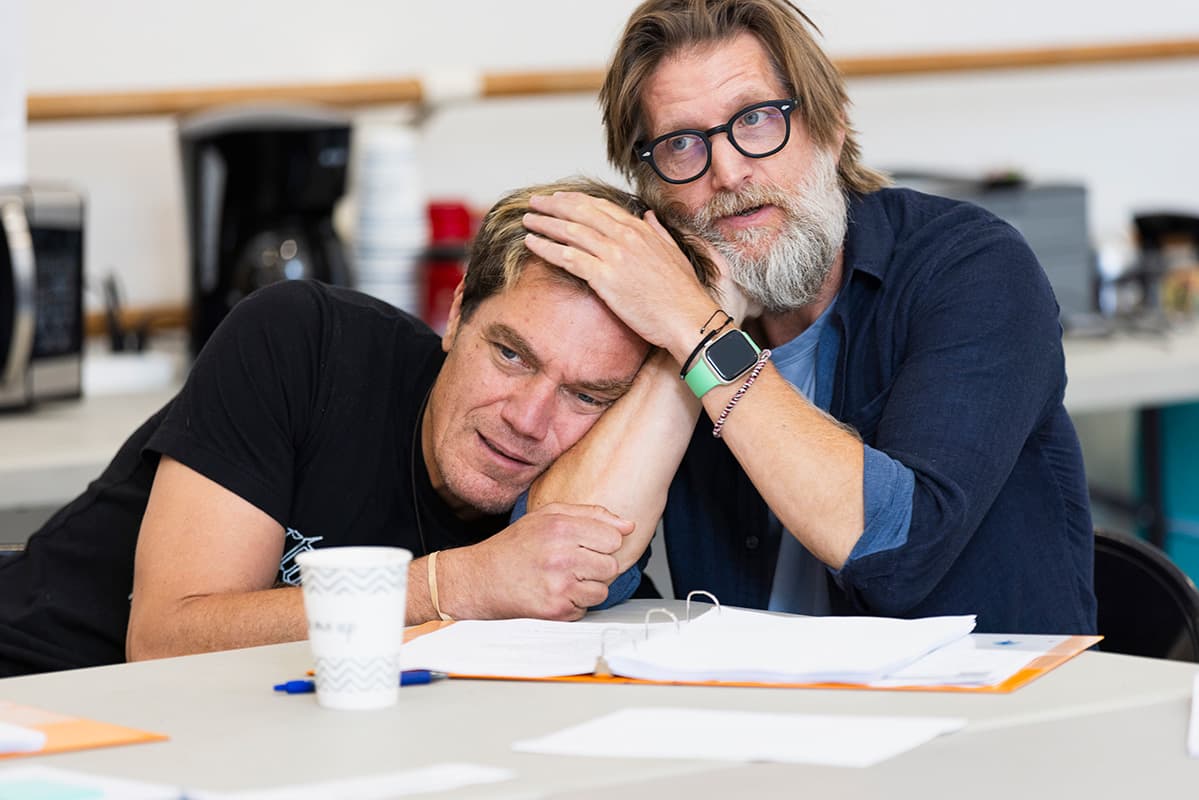
Arbus said she has strong opinions about things and instincts and responses to what’s happening in the room, but she described her job as a director as “giving people space to experiment. You do have to make decisions. It’s easier when you’ve given people a little air to experiment.” Though “some directors are genius choreographers—gorgeous dance onstage—it’s not relevant to me, stage left or stage right. You just want it to feel authentic in some way to the production and to that actor and to that moment.”
She said she found it “very useful to argue with people about the plays.” In the development process, “with designers you have a good amount of time when you are stewing on a piece and having disagreements, and I find that clarifying and valuable.” As part of her preparation, she reads reviews of previous productions of a play and interviews with the actors, and if possible speaks directly with directors and actors who have dealt with the play. She said she watched film adaptations, if available. “Bad ones are as informative as good ones. You become aware of the pitfalls,” she commented. But “for actors it’s different. It can be very damaging to see other interpretations.”
As theaters close and shorten their seasons and fret over their audiences, engaging with theater in whatever capacity can appear contrary to reason. For Arbus, “There’s nothing like it. It’s even more important now when we spend so much time alone or in front of screens. To be in a room with other people hearing ideas in conflict with one another. It is fundamentally democratic,” she said. “It is an honorable thing to do, and I love doing it. Sometimes I wish I didn’t. I would have more money in my bank account.”
Paul David Young is a playwright, critic, and translator. He has two upcoming play premieres: Livia: A Roman Tragedy at The Flea in October 2026, and A Picnic for Orpheus at La MaMa in October 2027.