Ben Manley: Digital Thoreau
Word count: 1621
Paragraphs: 12
The first time I met Ben Manley, he told me he would sleep in his car for his next musical project. This was in September at a Blank Forms concert in Clinton Hill. We were both there to hear Swedish musician Marcus Pal experiment with just intonation on a prepared, open-faced, upright piano. After the concert, we talked; he said that he had been La Monte Young’s sound engineer and that he was preparing to hike into the woods at 3 a.m., rig a microphone, press record, and over the course of seven hours attempt to capture the sounds of birds, like the barred owl, the wood thrush, and the veery. He would camp out in Chickadee Valley, a 150-acre farm on the border between Kent, Connecticut and Amenia, New York, where Rex Brasher—the Audubon of the Housatonic—painted some of the very birds Manley hoped to hear. (The project was for an October 7 symposium by The Rex Brasher Association.) The climax would be the “dawn chorus,” when birds of every feather greet the rising sun. I got the impression that he wanted a seven-hour long crescendo, but I wondered whether a recording of birds was really music at all.
My first encounter with Manley’s music itself was on SoundCloud. “Recorded at Dave Marshall’s cornfield near Ten Mile River on 11/8/20, with no processing” was the first thing I listened to. The picture accompanying the sub-eight-minute recording depicts Manley wearing a black fleece, black beanie, and glasses. He’s squatting in the grass, microphone beside him, loudspeaker behind him, mowed corn around him, while he turns knobs on a little black box. He looks like a scientist. I put on headphones, pressed play, and relaxed to a soundscape of lulling cowbell, cooing birds, and a white noise of rural cars. And then the cowbell got louder, and louder, until it got so loud that I had to turn the volume down. It felt like someone was flicking my brain. “Okay, now it’s your turn,” I heard him say, and a female voice asked, “In that same rhythm?” She hit the cowbell a few times (“Harder!” says Manley) before it just stopped.
Then I listened to “Recorded at Clark Dry Lake on 11/16/18, with live processing in performance on 3/19/19.” Again just under eight minutes, this was captured at the arid desert basin outside San Diego. It brims with a steady wind, like something out of a David Lynch film, before Manley begins to walk around with a clanging cowbell, as a coyote, it seems, howls in the distance. It fades out calmly, musically. “Live processing” was the key phrase in the title.
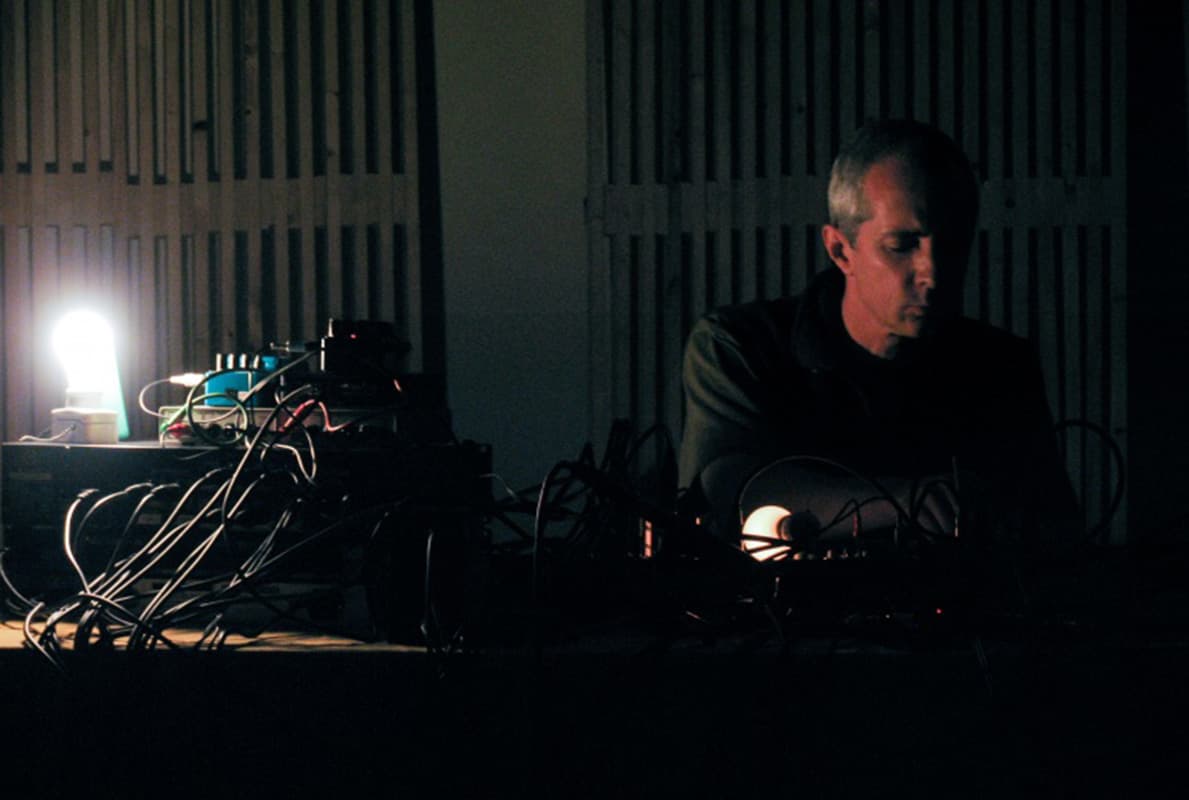
Manley processes field recordings through equalizers, mixers, compressors, and reverb to create unique electroacoustic environments in front of live audiences. “Minimalist moves,” is what he calls his slight interventions. “Clark Dry Lake” was realized in front of an audience at the Fridman Gallery in the Bowery, where he lives. Other performances are not so serene. In “1+1=3” (an excerpt is on YouTube), Peter Zummo strolls around a lawn on Governors Island, making foghorn and elephant sounds with his trombone, while the late drummer Michael Evans jangles bells, strikes wood claves, and rolls around in the grass, wearing what appears to be a wizard’s costume. All the while, Manley pipes these outdoor sounds indoors for the audience. Deep, electronic ambience mixes with the acoustic clamor as Manley elegantly smooths out feedback, creating the composition in real time. His role in the sound fabric, he says, is to employ “concise, predetermined moves of faders or switches in the concert room with other people.”
Even though Manley is not sure he is making music at all, his planning and manipulation of sound add an unmistakably human element to the recordings, which is perhaps one criterion for music. For “Clark Dry Lake,” he says, he had a plan before he even trekked out to the no man’s land for how he wanted to process the sound later. He would slowly add lush reverb, increasing the natural resonance of the landscape. “Even if [my compositions] don’t involve musical convention,” he says, “I think I'm looking for musical effects.” Chief among these is for an audience to have a transcendent experience of beauty, a goal shared by many of Manley’s forebears, including Young. “The thing that I like,” Manley says, “is doing a performance and at the end it’s really clear to everybody, hopefully, that something happened in this room tonight.”
In Manley’s hands, the recording device becomes an instrument. His live processing practice is akin to a musician playing from a score, embellishing it with ornaments and improvisatory elements. Igor Levit and András Schiff don’t employ the same trills, turns, and tempi in playing Bach’s Goldberg Variations, but they are reading the same notation. Likewise, Manley might use reverb at a point in the recording where another engineer might use a compressor. For the Governors Island performance, “I imagined myself, as a way to have some gumption or fun, as a violin player in front of a score. But, instead, it was Ben Manley turning knobs while listening to this playback.” Manley is not the first composer to double as a sound engineer; he is the inheritor of a recent tradition which he is modifying in a unique way.
The recording device used to be a tool, a means to hear Beethoven in your kitchen and Chuck Berry in your bedroom. Now it is a musical instrument unto itself. It all started with John Cage, whose Cartridge Music (1960) requires performers to insert objects into a phonograph cartridge, amplifying the scratching, scraping, and squishing sounds of any thingamajig you can think of shoving in there. Then, as an antidote to the dominant poles of post-WWII modernism, the total serialism of Boulez and Stockhausen, and the indeterminacy of Cage’s music, composers like Philip Glass, Steve Reich, Terry Riley, La Monte Young, Alvin Lucier, and David Tudor began to concern themselves with the beautiful, rather than the merely interesting. Having worked with the last three men, Manley is firmly in their lineage. But he is no copycat.
He started out as a percussionist, went to Wesleyan, and studied and played West African music. In 1990, he started as a recording engineer for Roulette, when it was still in Jim Staley’s studio on West Broadway. Since then, Manley has been a sort of Nikola Tesla of the New York experimental music scene. In his book, American Music in the Twentieth Century, longtime Village Voice music critic Kyle Gann includes him in a trio of composers—along with Ron Kuivila and Nick Collins—whose work typifies “virtually a separate genre of acoustically aware electronic music” pioneered by Alvin Lucier. Manley denies this characterization. Although when Gann was writing (1997), Manley was experimenting with the “semi-improvised” (his phrase) tabletop electronic methods of David Tudor and listening to Alvin Lucier’s sine wave concoctions, he tends to think bigger and now, more naturally, outside the concert hall. Dissatisfied with sitting at a table, he went to the woods, a digital Thoreau.
But not a New Age one. “Some of the New Age-y recordings are God-awful,” he says. “They’re mixing wave sounds from the beach with sounds from the forest and they call it relaxing. To me, that would be just absurd.” Instead, they are musical in a specific way. Usually, people who record wildlife use parabolic microphones, which is, Manley says, “not the way we hear with our ears.” He says they “tend to cut out sounds from all around,” like listening through a “paper towel tube.” He doesn’t even own parabolic microphones. Instead, he uses the same kind of microphones that he uses to record acoustic instrumental ensembles on stage (which he spends a good chunk of his time doing; he’s recorded around two-thousand concerts). Why? “I'm capturing ambient sound the way our human head would hear it,” he says.
Manley hesitates to describe the effect as “immersive,” but the three-minute clip he sent me of his nocturnal recording on the Brasher property—that seven-hour-long camping trip—really does feel like my head is in the woods at 3 a.m., rushing water drowning out birds, distant train whistle. There is a fantastic moment (“ear candy,” Manley calls it) when the neighbor leaves for work in their car, and the tires fade in, crunching up the dirt road where the mic is placed, and then fade out, from left to right, like some kind of natural feedback.
Overall, he says, the project was a “bust.” There was, for example, horrible thermal hiss from the mics themselves and an “extremely minimal” dawn chorus. Plus, the river sounds are annoying. But perfection, or even quality, is not the goal. Manley was slated to play some of the recording for a live audience gathered at Chickadee Valley for the Rex Brasher symposium. The Rex Brasher Association calls it “Woodland Symphony;” Manley prefers “The Sounds of Chickadee Valley.” But he is prepared to revel in failure, and actually thinks the Association’s title forms an ironic contrast to what he actually recorded. After all, the whole project is “more like a quest than a slam dunk,” he says. Think of John Cage’s words: “Everything you do is music, and everywhere is the best seat.” For Manley, the same goes for nature. Even if a tree falls in the woods and no one’s there to hear it, it’s still music, especially when Ben Manley runs it through his mixers.