Heather Dewey-Hagborg: Hybrid: an Interspecies Opera
Word count: 916
Paragraphs: 7

On View
Fridman GalleryNovember 1–December 13, 2023
New York
Over synthesized and sustained chords, a baritone voice chants out the libretto, “You wouldn’t know that’s a pig heart. I could tell you it was human—you would believe that” in Heather Dewey-Hagborg’s new film Hybrid: an Interspecies Opera (2022), as the camera lingers on ultrasound imaging of a pig. A researcher gently caresses the sedated creature while it breathes evenly amid testing. Dewey-Hagborg’s own voiceover asks, “Are you still other if you come closer and closer to me?” in this part documentary, part autotheoretical journey, and part memorial interspecies opera. The film traces the evolution of the biomedical phenomenon of xenotransplantation—the genetic implantation of human cells in an animal host for the purposes of growing and eventually harvesting organs—alongside the dual narrative of Hagborg’s 3D printing and firing of porcine figures in clay in an opera far from melodramatic.
Dewey-Hagborg’s transdisciplinary practice, rooted in artistic research, has often raised hairs for its biopolitical revelation and dogged critique. Dewey-Hagborg has previously created in the intersection of biohacking and the musical: her installation Lovesick (2019) collaboratively configured a retrovirus with biotech company Integral Molecular to infect its human host with a gene that increases the production of the so-called “love hormone” oxytocin in the body. She set the film to Francesco Landini’s fourteenth-century ballad of a woman lamenting a non-reciprocal love interest, rewording it to list the protein molecule letters CYIQNCPLG. In the exhibition Hybrid: An Interspecies Opera at Fridman Gallery, on view through December 13, 2023, Dewey-Hagborg stages another kind of revelatory reckoning, this time in the biomedical arena in which pigs, one of our closest genetic relatives, host organs for human use. Dewey-Hagborg interviewed researchers at Ludwig Maximilians Universität, Munich, and the Massachusetts Institute of Technology, Boston, incorporating these observations in her original libretto, and set to music by Bethany Barrett. Structured in five musical movements, “pig3.0,” “interlude," “observation,” “nature?,” and “ritual,” a soprano, tenor, and baritone introduce current scientific research alongside observations intoned by Dewey-Hagborg herself. These vocalizations become polyphonic at parts, compounding porcine evolution with human interventions and cinematically crosscutting between archaeologists examining pig bones to ancient artworks such as a fifth-century terracotta calyx-krater attributed to the Persephone painter depicting Circe turning men to boars from the Metropolitan Museum of Art’s collection, cave drawings from Leang Tedongnge, Indonesia, and a pig sacrifice in a Roman fresco from the Archaeological Museum of Naples, Italy. As much as interviews and various musical movements convey the biases and limitations of Western scientific methods, artistic practice, and the public imagination of our contemporary moment, they resist pedanticism, leaning more into an interrogative pedagogy.
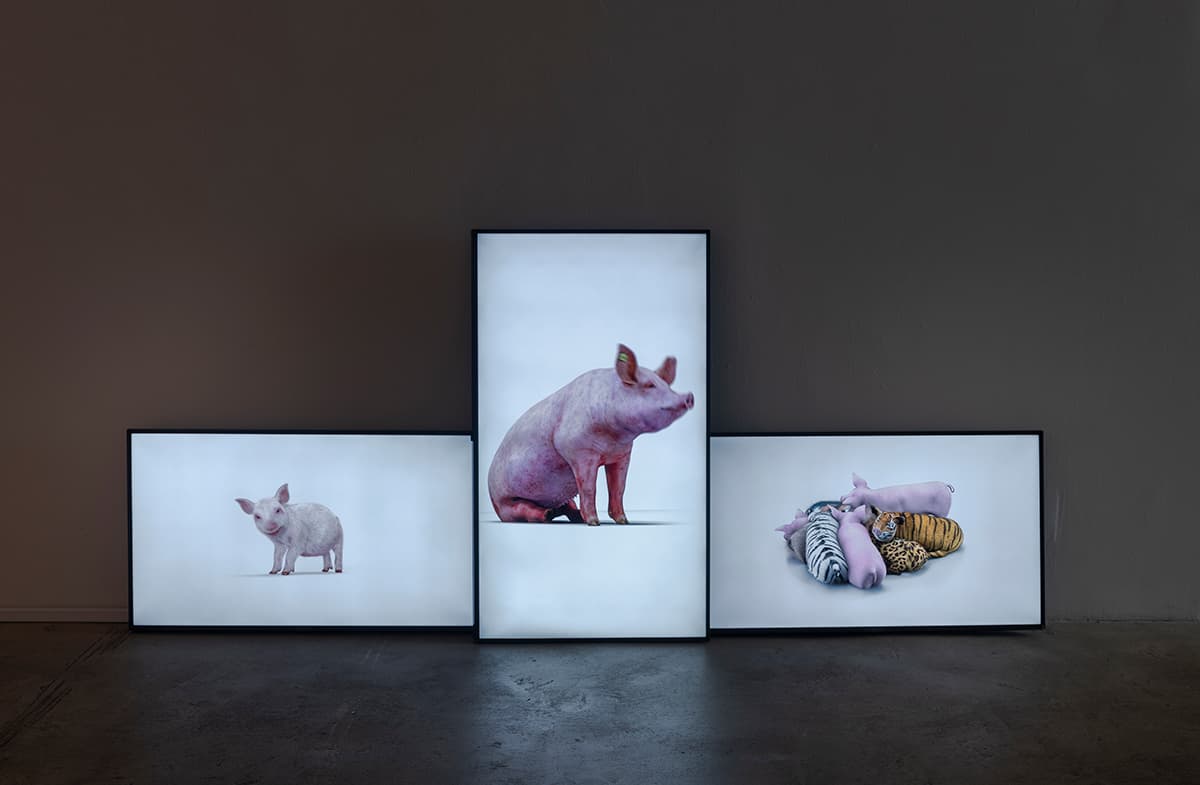
In these interspersing cinematic narratives and questions, Dewey-Hagborg traces a poetic chronology of human-porcine relations prior to and throughout the Anthropocene. In the space of the exhibition, a linear chronology on the wall begins 79–90 million years ago with the Boreoeutheria, or the ancient ancestor between the pig and human, and continues to 2023, with the second genetically engineered pig heart to successfully be transplanted to a human. It succeeds in suggesting that maybe this current cellular intertwinement in CRISPR technology is actually a progression of domestication and selection breeding. At the same time, it proposes a jarring new relationality. Surrounding the chronology, 3D-printed ceramic pig sculptures from the film rest—in parts, some split in half—on a windowsill and pedestals, evocative of their role in genetic engineering. Adjacent to the film, ceramic pigs in Ritual device (2022) face one another in a circle, whole and standing on glass platforms in a ritual all their own.
Beside those oriented in a circle, animations of pink pigs—Future pigs, plural (2022)—sweetly rendered and staring out at viewers breathe, seemingly snort, and stomp their feet. These are the piglets perhaps we expected to see, rather than those lying subdued on a surgical table. Dewey-Hagborg’s film conspicuously foregoes showing surgical procedures but alludes to them through the libretto and shaving of pig hair by the researcher. Dewey-Hagborg’s careful cinematic approach nevertheless suggests a deep respect for our closest relative, in contrast to their stereotypic portrayal as a lowly species. She resists showing pigs in pain or corralled in inhumane practices, even as we know such structures of scientific inquiry have enabled historic animal cruelty. Instead, she questions ethical entanglements in this current scientific “breakthrough” through the cinematic parallelism of scientific research with her own artistic research rendering pigs in clay. As she baldly voices over, “This deed was done by all of us,” a proclamation echoed by the singers in a particularly poignant moment.

At the beginning and end of the film, Dewey-Hagborg pictures herself digging the clay fire pit on a beach. Firing the clay pigs in the evening, she enacts a gesture of sacrifice, rebirth, and contemplation. After the fire has dissipated the next morning, she reaches into the sand to pull out a pig figure, which stares back out directly from her gloved hand. Surrounded by the pig figures and animations in the gallery, Dewey-Hagborg memorializes the closeness that traverses the chasm between self and other and perhaps suggests that it is too close.
Dewey-Hagborg will push this closeness further in a forthcoming live opera of Hybrid: An Interspecies Opera at the Exploratorium in March 2024.
Laurel V. McLaughlin (she/her/hers) is a writer, curator, art historian, and Curator and Director of the Collective Futures Fund at Tufts University Art Galleries. She is completing her doctorate in the History of Art at Bryn Mawr College, and her work has been published in Art Papers, BOMB Magazine, The Brooklyn Rail, C Magazine, Performa Magazine, Contact Quarterly, Performance Research, and women & performance, among others. She is currently co-convening the symposium Magical Thinking at MASS MoCA with manuel arturo abreu and conducting research for a forthcoming exhibition supported by a 2022 Andy Warhol Curatorial Research Fellowship.