Barkley L. Hendricks: Portraits at the Frick
Word count: 967
Paragraphs: 8

On View
Frick CollectionPortraits at the Frick
September 21, 2023–January 7, 2024
New York
Barkley L. Hendricks’s paintings shine with a kind of affect that one is inclined to call “beautiful.” And, indeed, they are. Yet they are loaded with something too tense, too bristling with heat to fit neatly into such a definition: something else is here, too. They stand in forceful excess of beauty, spilling over with the intense and masterful performativity of Black people inhabiting the canvas, throwing looks, striking poses, and articulating style. There is an irreducible there-ness to the way that Hendricks’s figures exist in these frames, a resolute and absolute way in which they hail us with the wholeness of their being.
I want to start with Misc. Tyrone (Tyrone Smith) (1976), which is hung in the first of the exhibition’s two main galleries, to clarify what I am trying to say. No matter where I stood in the gallery, I couldn’t seem to get away from this painting: I couldn’t evade the searingly self-assured comportment of its titular figure, nor the bright pink background he stands against. His lithe body stretches from the top to bottom of the canvas, and then extends beyond it, the tip of his forehead and the bottom of his legs absent from view. He leans forward, as if preparing to address someone, and bores into our reality with his gaze, an intractable combination of precision and offhandedness. All of this was magnified when Antwaun Sargent, co-curator of the exhibition, shared that the painting was born out of an impromptu street photoshoot lasting about forty minutes, drawing crowds eager to take in the creative rapport unfolding between Hendricks and Tyrone. It is this texture of Black performance and assembly that seems to animate Hendricks’s ways of seeing the world, and that his paintings bring to bear.
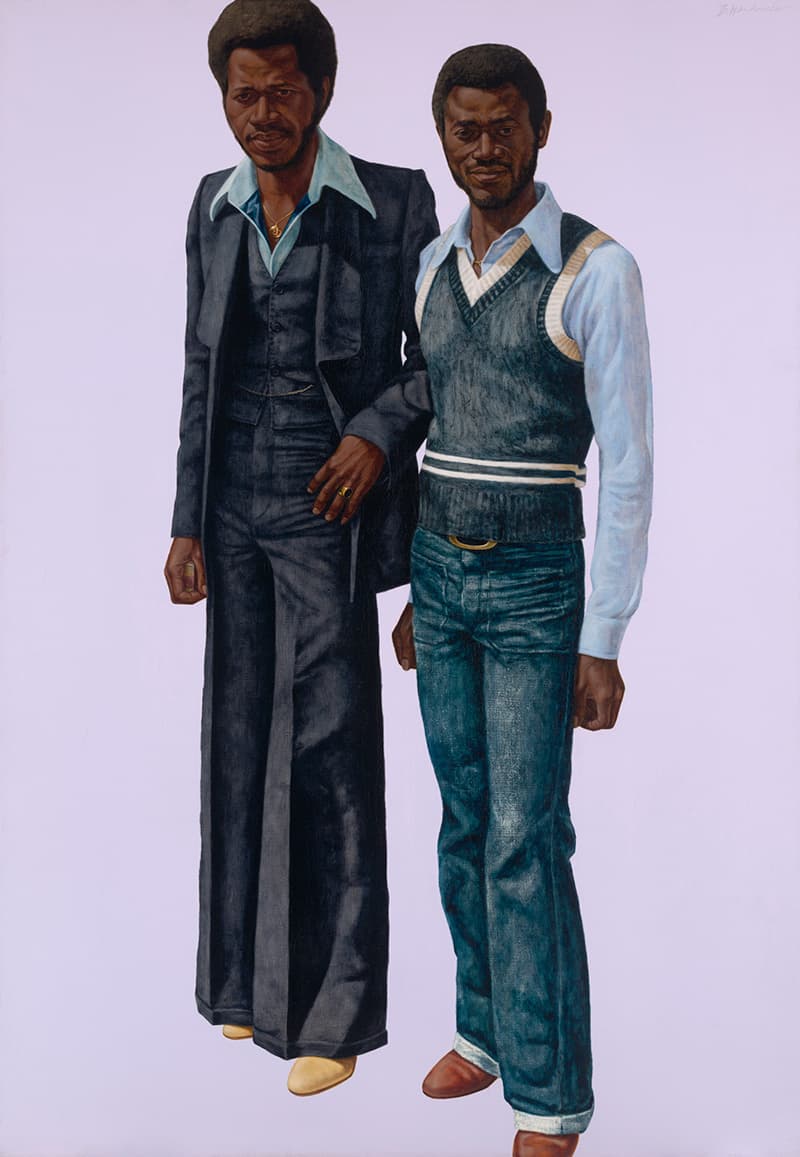
To a large degree, the visual power which so insistently draws the eye into Hendricks’s paintings stems from his deep command of color and color theory. Paintings like APB’s (Afro-Parisian Brothers) (1978), in which two denim-clad men seem to float against a lavender background, are cut with sharp distinctions between figure and ground, fomenting a crisply assertive three-dimensionality. The flatness of these monochromatic backgrounds takes us out of any knowable world governed by space and time. But the figures in each of these portraits seem to utter, “I am here before you,” thick and gleaming with an obdurate presence.
Underlying this is the undeniable singularity of the figures who caught Hendricks’s eye as he moved about the world. But there is also a technical cleverness that guides our encounters with the paintings. The backgrounds are applied with acrylic paint, while the figures are painted in oil, striking us with a tension between the former’s firm durability and the latter’s relative softness.
Ironically, some of Hendricks’s best negotiations with color lie in what is conventionally framed as the absence of color: white. Stepping into the smaller of the two galleries, one sucks in a new air of color, whisked into a stirring juxtaposition of brown skin beautifully cast against white backgrounds. The suite of five portraits on view here empty any claim to “neutrality” associated with the white background. One of them, Lagos Ladies (Gbemi, Bisi, Niki, Christy) (1978), occasions a meditation on the beautiful chromatic range of Black skin tones. Four Black women donning white nurse uniforms wrap their arms around one another, their body language exuding a quiet tenderness. The differences in their skin tones are just subtle enough to truly be seen against the white garments and backgrounds enshrining their bodies. I am reminded of Zora Neale Hurston’s lamentation: “I feel most colored when I am thrown against a sharp white background.” In Hendricks’s paintings, the immobilizing shock that Hurston conveys in this grievance are transformed into a celebration, with the white ground becoming a site of careful attention to and delight in Black skin.

Hendrick’s paintings luxuriate in the sheer being of Blackness in the world, and for this reason, I will keep going back to see The Frick’s presentation again and again. That being said, the exhibition leaves room for some uncomfortable questions. Despite all the extraordinary presences on view in the galleries, I couldn’t help wonder about particular absences: the show overlooks a key site of engagement in Hendricks’s work, namely, Black sexuality and nudity. Not only did Hendricks paint several nude figures throughout his career, but he also thought meticulously about how to untether the naked Black body from stigmatization and hyper-sexualization. What does it mean to quiet these dimensions of Hendricks’s painterly practice? What accommodations are being made in that choice? It is worth holding some skepticism around where this exhibition is sited—a museum which has never before showcased a Black figure let alone a Black artist—and about more general tendencies of historically Eurocentric institutions to assimilate Black art and figures into its existing paradigms.
The last time one of Hendricks’s paintings was hung at 945 Madison Avenue—where the Frick currently resides—was in 1994 on the occasion of Thelma Golden’s historic show Black Male, an exhibition which was rigorously concerned with all the thorny complexities of Black male embodiment (including those of desire and sexuality). As I visited the show, I thought about this legacy, and what lines of inquiry it opens up for our contemporary viewership of Hendricks at the Frick today. Either way, one must applaud what has been enlivened here through the pulsing chroma of Hendricks’s palettes, the postures of his sitters, and the rigor of his eye.
Zoë Hopkins is a writer and critic living in New York, NY.