New Possibilities--“The Greek Alphabet Paintings” of Jack Whitten
Word count: 815
Paragraphs: 8
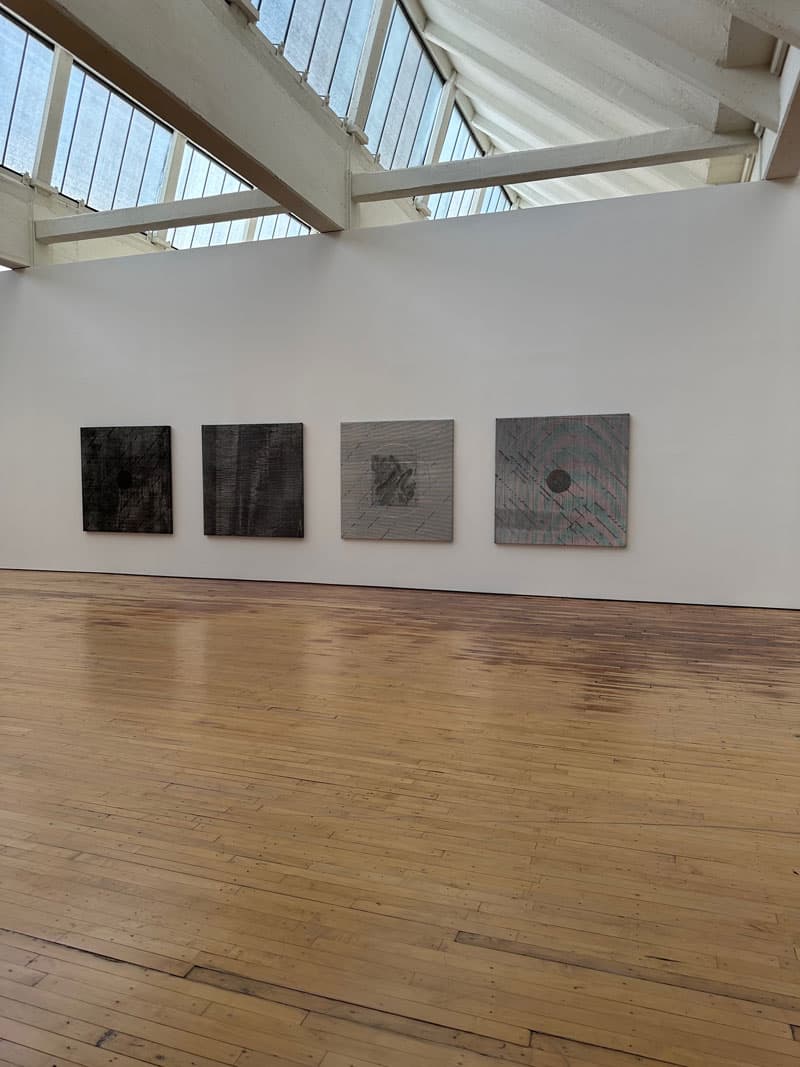
I went to see Jack Whitten’s exhibition, The Greek Alphabet Paintings, when the show first opened at Dia Beacon in November 2022. Although I was familiar with many of Jack’s paintings, I had not previously seen any of these paintings, almost no one had. The paintings were conceived as a group; this was the first time so many of them could be seen together.
At the opening, I spoke with the curators, Donna De Salvo and Matilde Guidelli-Guidi, as well as collectors who had loaned their paintings, gallerists and museum professionals who had championed Jack’s work, art historians, fellow artists, and Jack’s family. All of us were fans and very excited to be able to see these paintings. They were unusual and unfamiliar to me. I could not calm down. The more I looked, the more I realized that I hardly understood anything about them. Did Jack make the paintings by hand? Or did he use tools or even machines of some kind? I couldn’t figure it out. In what order did he apply the layers of paint? Even that was impossible for me to decipher. There was a strong consistency between the paintings, as well as great variety. How could these paintings be so different from each other and so much the same? In all the paintings contrasts of black and white caused blurs and movements of light. A new kind of electrified painted light sizzled and buzzed in all the paintings. Now looking at these paintings, is this the light in which we now live? Or is it the light from the past that we have lived through, a light that has changed us?
In June, I went back to see the paintings for a second time. I walked into the exhibition a few minutes before the gallery was officially open. Outside there was a cloudless sky and the gallery was filled with strong, slanting, early morning light. The paintings glowed and revealed themselves. They were entirely clear about what they were, which couldn’t be denied. If I didn’t understand, that was my problem. I couldn’t locate the surfaces. The blacks, grays, and whites buzzed and shifted, sometimes shimmered with color. Were the paints tinted with hues or was the color that I was seeing optical? I couldn’t tell. Did it matter?
I went back again before the show closed with an old friend of Jack’s who also comes from Alabama, the painter, Guy Goodwin. Guy had also not previously seen these paintings and would be seeing them for the first time. With him, I thought, I could test what I had experienced from the paintings. He had many of the same questions that I did and experienced the paintings in a similar way. I was confident then that I hadn’t imagined what I saw on my previous visits.

While Guy looked at the paintings and talked with other visitors about the questions all of us had, I decided to get down to business. I carefully studied each of the paintings in the order in which they were painted. Jack titled groups of paintings after the letters of the Greek alphabet, as he proceeded, so it was easy to put the paintings in sequential chronological order starting with the “Alpha Group” and ending with the “Omega Group.” I wanted to see what Jack had discovered in each group of paintings and how these discoveries changed his decisions in later paintings. Progressing from letter to letter through the Greek alphabet, how did Jack use what he discovered to form a new language of painting. I tried to follow the threads connecting his discoveries. Would he continue with the shifting flat space he had first used, once he had discovered more complex spaces of diagonals, recessions, and shifts. How did the two kinds of space relate to each other? How would he use hue, whether optical or tinted, along with the black and white contrasts as the paintings developed?
As I followed the evolution of his paintings, I wished that I had seen the paintings at the time they were newly painted. I kept thinking that then I would have better understood. Perhaps that is true and perhaps it is not. But I am sure that everyone, especially every painter, that saw this show at Dia Beacon realized that there were possibilities for painting that no one had ever imagined which Jack made available.
Now that we have seen these paintings, the history of seventies painting will change. It is now undeniable that experimental paintings were being made. The new possibilities for painting invented during this time will from now on circle around what Jack accomplished.
David Reed is an artist. He studied at the New York Studio School in the sixties and has lived and painted in New York since the early seventies. He will have a one-person show at Rodder in New York in the fall of 2026.